
Maritime
Lekki Freeport Terminal : Dockworkers Secure 150% Pay Raise in New Union Deal

By Temitope Adebiyi, Correspondent
Lekki Freeport Terminal has signed a Collective Bargaining Agreement (CBA) with dockworkers, boosting salaries and allowances by up to 150 per cent.
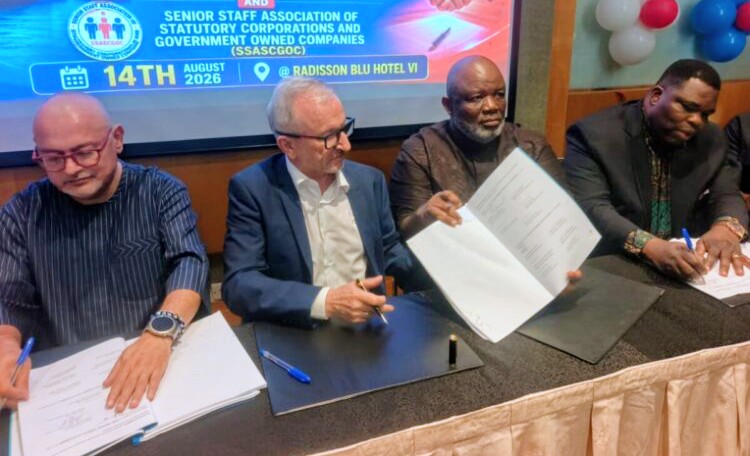
Signed in Lagos over the weekend, the agreement was executed by Comrade Francis Bunu Abi, President-General of the Maritime Workers Union of Nigeria (MWUN), and Comrade Akinola Bodunde, President of the Senior Staff Association of Statutory Corporations and Government Owned Companies (SSASCGOC) NPA branch.
The signing ceremony at the Radisson Blu Hotel in Lagos brought together Lekki Freeport Terminal CEO Capt. Jedrzej Mierzewsky, his management team, and union representatives
Addressing reporters after the signing, Bunu described the agreement as a major breakthrough for dockworkers, saying the 150 per cent increase was achieved through sustained negotiations and dialogue rather than industrial action.
He commended the LFT management for what he described as its commitment to improving the welfare of Nigerian workers, declaring that the terminal currently offers some of the best remuneration packages among port terminals in Nigeria.
“We have gotten 150 per cent increase in workers’ salaries. It has never happened before,” Bunu said.
He explained that the union’s negotiating position was based on the need for Nigerian workers to receive remuneration comparable to that of workers performing similar jobs in other parts of the world.
According to him, dockworkers in Nigeria perform the same duties, operate similar equipment and work under comparable conditions as their counterparts abroad and should therefore not be treated as cheap labour.
“One thing about negotiation is for you as a union to tell management the reality. We as Africans earn less than our colleagues in other climes. Let management compare our salaries with what they are paying workers at other ports. We are doing the same job, using the same cranes, working in the same terminal and bringing the same ideas,” he said.
Bunu stressed that the union would continue to push for better remuneration and improved working conditions for maritime workers.
“Africa is not where you come and get cheap labour; it is where you come and get quality labour. If you want me to work like those in the US, then pay me like those who are in the US,” he said.
He added that the union’s commitment to workers’ welfare remained its primary responsibility, noting that achieving the agreement required focus, persistence and adherence to the principles of collective bargaining.
Bunu also disclosed that negotiations for a general dockworkers’ National Joint Industrial Council (NJIC), spearheaded by the Nigerian Maritime Administration and Safety Agency (NIMASA), would commence soon.
He said the initiative would provide an opportunity for broader improvements in the welfare and remuneration of dockworkers across Nigerian port terminals.
According to him, the new LFT agreement currently represents the highest remuneration increase recorded for workers at any Nigerian port terminal.
He noted that the agreement was reached without protests, strikes or disruption of port operations.
“It is done through lobbying. This job is being done everywhere in the world. I have even been to London because of this CBA to find out what they are paying our contemporaries in London. We are getting to that point and that is our next phase,” Bunu said.
He maintained that trade union leaders must remain firm during negotiations and avoid compromising the interests of their members.
Also speaking, the General Manager, Government Relations and Security, Lekki Freeport Terminal, Mr. Fubara Awanta, described the negotiation process as lengthy and challenging, saying it lasted more than four months.
Awanta described the new agreement as a “people’s CBA”, saying its implementation would provide improved benefits for workers across different categories within the terminal.
“What we are exhibiting today is a people’s CBA, in the sense that everyone inside the terminal, upon its implementation, would see additional progress,” he said.
He acknowledged the roles played by MWUN, SSASCGOC and the LFT management in bringing the negotiations to a successful conclusion.
According to him, the process involved painstaking negotiations between the two unions and the terminal management and took approximately four months to conclude.
Awanta had also played a key role in facilitating the maiden CBA between the unions and LFT management in 2024.
Explaining how the negotiations were concluded without industrial action, he attributed the outcome to perseverance, sincerity and a shared commitment to the efficiency of the terminal.
“It takes spirituality, perseverance and sincerity. Our goal is to ensure efficiency of the terminal,” he said.
He noted that the maritime sector remains critical to government revenue generation, stressing that all stakeholders have a responsibility to ensure that port operations remain efficient and productive.
“It would be a disservice if we don’t have that empathy to see that what government is supposed to generate to take care of citizens is gotten,” Awanta added.
On his part, the President of the NPA branch of SSASCGOC, Comrade Akinola Bodunde, disclosed that the latest agreement also addressed some provisions that were not adequately captured in the previous CBA.
Bodunde said negotiations for the new agreement began in February 2026, while the previous agreement was signed in March 2024.
“Some of the items omitted in the previous CBA were improved upon and now we are good to go,” he said.
He explained that the increases were not uniform across all categories, with some allowances receiving 150 per cent increases, while others recorded increases of 80 and 60 per cent.
The affected benefits include overtime, weekend work, public holiday allowance, transport, feeding, utility, housing and hazardous allowances, among others.
Bodunde urged dockworkers to reciprocate the improved welfare package by increasing their commitment to the terminal’s growth and operational efficiency.
He particularly called on workers to support the management as Lekki Freeport Terminal prepares for the next phase of its development, including plans for the commencement of Phase II of the Lekki Port project.
“We have to support them also because they have supported us. The workers must support the management and put in their best,” he said.
The new CBA is expected to take effect across the relevant categories of workers following the completion of its implementation process, further strengthening industrial relations and workers’ welfare at the Lekki Freeport Terminal.


Cabotage Enforcement is My Priority: DG NIMASA

Customs Renovates Ife Girls’ School, Pledges University Scholarships

Tinubu Applauds Coca-Cola’s Planned $1b Investment

2027: Northern Muslim Women Declare Support for President Tinubu

Dakuku Peterside: Weak Institutions Stall Nigeria’s Wealth, Prosperity

Inside Nigeria’s Sea Power: The Rise of NPA as a Maritime Powerhouse

Adebayo Williams At 75: A Missing Honour — By Femi Macaulay

High Hopes as Dangote Launches ₦2.15 Trillion IPO

2027: LP chieftain sues WAEC, UNN, NYSC over Obi’s credentials

Tension in Osun as Masked Gunmen Kill Adeleke’s Ally ‘Emir’ at Peace Meeting

Tribute to a Colossus: The Eternal Legacy of Alhaji Bamanga Tukur (1935–2026)

US Praises Nigeria for Ending 12-Year Maritime Restrictions; Oyetola Credits President Tinubu

Environmental sanitation resumes in Lagos tomorrow

Tribute to a Legal Icon and Master Administrator: Alhaji Yahaya Bukar-Gana

Panel recommends 60-month timeline on State Police inauguration

Customs smashes smuggling ring at Tin-Can port, seizes illicit drugs worth ₦18.9b

Customs nets ₦178b at PTML, Miko resumes office

NIMASA Calls on The Media to Help Drive Blue Economy Growth

NIMASA Partners Malta to Fast-Track Full Automation of Nigerian Ship Registry

History as Customs CG Adeniyi bags First NIJ alumnus fellowship

“A Blueprint for Prosperity: How Amb. (Engr.) Omar Suleiman Will Transform Adamawa State”

Apapa Customs Intercepts ₦12.7b ‘Canadian Loud’, Expired Drugs in Lagos

Misclassified Levies: Senate Clears Customs of ₦62.2bn Under-Remittance Claim
