
News
Pa Fasoranti, Afenifere leader, dies at 100

By Saheed Olatunji, Reporter
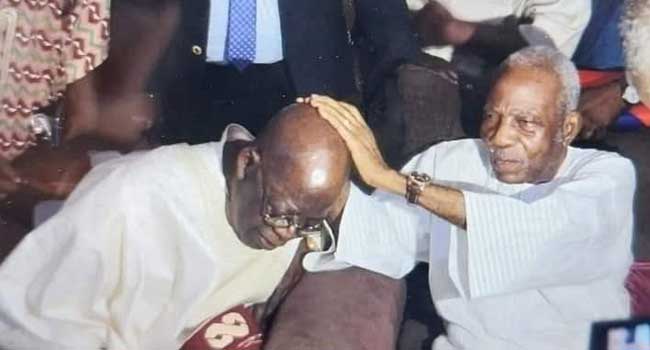
Pa Reuben Famuyide Fasoranti, Afenifere leader has passed on. Yorubaland and beyond mourn him as an eminent teacher, reputable politician, ideologue, elder statesman, man of contentment, mentor, role model, and gerontocratic monitor of political processes in the post-Abraham Adesanya era.
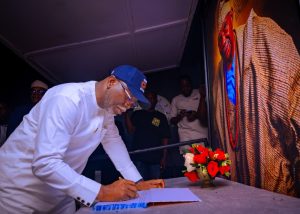
PHOTO: Ondo State Governor Lucky Aiyedatiwa paying his condolences to the foremost leader of the Pan-Yoruba social-political organisation, Afenifere, late Pa Reuben Famuyide Fasoranti at his ijapo residence on Tuesday in Akure, Ondo State….Today
The Akure political leader was born on May 11, 1926, in Uso, Ondo State. He died at the age of 100. His life, according to many political analysts, was marked by service, integrity, and leadership grounded in the traditional Yoruba values of Omoluabi.
He dedicated his life to education, unwavering political activism, and resilience in the face of adversity.
After his elementary education at Uso, he attended Ondo Boys’ High School, Ondo; Yaba Higher College in Lagos; and the University College in Ibadan, where he earned a higher degree in English/Geography. He travelled to Australia for a Diploma programme, enduring the stress of a six-day round trip. In reminiscence, he told reporters in Lagos at the time: “It was excruciating.”
Many believe that his academic journey laid a strong foundation for his future exploits, particularly in education and political leadership. As a university student, he also entered politics to learn, cultivate progressive ideas, and undergo grooming.
A lover of the teaching profession, Fasoranti taught at his alma mater, Ondo Boys’ High School. He remained a teacher for life.
He was principal at Oyemekun Grammar School and Iju-Itaogbolu Grammar School, where he imparted knowledge and values to students. He also served as principal of Christ School, Ado-Ekiti, even after retiring from formal teaching roles.
He established Omolere Nursery and Primary School, Akure, and Akure High School, Akure, reflecting his enduring footprint in education.
Fasoranti joined the Action Group (AG) Students Association on campus. His affiliation with AG and later, the Unity Party of Nigeria (UPN), founded by the late Chief Obafemi Awolowo, marked the beginning of his political journey. Under the UPN, he served as Ondo State Commissioner for Finance from 1979 to 1983. His tenure focused on improving the state’s financial management and development, demonstrating his commitment to public service and governance. Outside public office, he was witch-hunted. He was tried for the murder of political opponents. But Fasoranti could not hurt a fly. He triumphed. There was no evidence to nail him. He was set free. The military could also not put him in prison after the 1983 coup. He never stole public funds.
Fasoranti’s alignment with Awolowo’s vision and his dedication to preserving his legacy made him a stalwart in Yoruba politics. After the coup of 1983, he was detained and tried for the assassination of political opponents. It was a big lie. The trial was futile.
During the June 12 struggle, he was always with the Afenifere leader, Ajasin. But until fate catapulted him to Afenifere leadership, he was an unsung hero: consistent, loyal, and committed to Awoist principles, but never in the newspapers like the Ijebu Mafia, the trio of Abraham Adesanya, Olaniwun Ajayi, and Ayo Adebanjo.
In 1999, he refused the Ondo State governorship. The coast was clear. He was the most senior politician. There was no formidable rival. But he declined. He said he had become a widower, having lost his beloved wife. He therefore threw his weight behind the AD candidate, the late Chief Adebayo Adefarati. He remained a loyal party elder.
Fasoranti inherited an utterly divided Afenifere as leader. The organisation was at its low ebb. The unresolved, protracted crisis that began in D’Rovans, Ibadan, had weakened it: Afenifere set aside its time-tested criteria of age, hierarchy, long service to the group, and loyalty, and picked Olu Falae as the AD presidential candidate for the 1999 poll instead of Bola Ige. Ige fought back. The Yoruba Council of Elders (YCE), led by Pa Emmanuel Alayande, stepped in. Both groups were never on the same page.
No wall separated Afenifere and AD. Membership was almost identical. Once, as group leader, Fasoranti may have been misled into saying that the AD congress that threw up Mojisoluwa Akinfenwa substantially complied with the laid-down guidelines.
When the organisation split into two, following the ‘Akure Declaration’ by Fasoranti that Senator Mojisoluwa Akinfenwa, and not Chief Bisi Akande, was the National Chairman of the Alliance for Democracy (AD), aggrieved Afenifere chieftains, including Akande, Aremo Olusegun Osoba, Asiwaju Bola Tinubu, Senator Biyi Durojaye, Pa Olatunji Hamzat, Prince Tajudeen Olusi, Otunba Niyi Adebayo, the late Alhaji Lam Adesina, and Chief Michael Koleoso, picked a Second Republic Senator, Pa Ayo Fasanmi, as the deputy leader.
The faction later proclaimed Fasoranti as leader. Key members of the Fasoranti faction include: Sir Olaniwun Ajayi, Chief Ayo Adebanjo, Senator Femi Okunrounmu, Basorun Sehinde Arogbofa, Chief Korede Duyile, Dr Fredrick Fasehun, Senator Mojisoluwa Akinfenwa and Chief Olu Falae. The division between the two camps became evident during the burial of Pa Adesanya at Ijebu-Igbo, when the chieftains fought a bitter struggle for supremacy.
The ’younger’ elements, led by Hon. Wale Oshun, a Third Republic House of Representatives Chief Whip, formed the Afenifere Renewal Group (ARG), which tried in vain to reconcile the two factions led by Fasoranti and Fasanmi. ARG members include: Dr Kayode Fayemi, Mr Ayo Afolabi, Mr Segun Odegbami, Mrs Toke Benson and Mr Kunle Famoriyo. A prominent ARG member, Mr Jimi Agbaje, left the group after defecting to the Peoples Democratic Party (PDP).
As the leadership crisis that engulfed the organisation in the post-Adesanya era escalated, other Afenifere intellectuals and compatriots – Prof. Bolaji Akinyemi, Dr Dapo Fafowora, Gen. Alani Akinrinade – quietly distanced themselves from the crisis in the fold and embraced other platforms for raising the national question germane to peaceful co-existence among the diverse ethnic groups making up the heterogeneous country.
Hope of reconciliation between the two camps was bright during the preparations for the anniversary of Pa Adebanjo’s 80th birthday. But a highly inflammatory media interview by the combative Adebanjo, in which he blamed the crisis on Tinubu, Osoba, and past All Progressives Congress (APC) governors, aborted the reconciliatory moves. Now, a few chieftains in the Fasanmi faction believed the tone of Adebanjo’s interview bungled the effort.
Later, Fasoranti grew fed up with the group’s growing contradictions, particularly when a section of it gravitated to their conservative rivals in the opposition party to drum up support for their presidential and governorship ambitions. He was not used to politics driven by money and financial inducements.
He called it quits with the organisation, lamenting that the goals of its founding fathers “are gradually being eroded.”
Fasoranti gave three reasons for his resignation. Apart from citing old age, he chided the chieftains for disloyalty. He also lamented that the organisation had strayed from the vision of its founding fathers, including Awolowo, Chief S.O. Sonibare, Chief Michael Ajasin, Chief Bola Ige, Pa Solanke Onasanya, and Pa Emmanuel Alayande, all deceased.
Unlike other ethnic nationalities, Yoruba have lacked a united and cohesive socio-political group for interest articulation since the death of Chief Adesanya. Consequently, many observers believed the once-vibrant mouthpiece was losing influence in the polity. In the 2015 election, the organisation, against public opinion, adopted former President Goodluck Jonathan, the PDP candidate, for a second term, thereby mocking its pedigree and history as a progressive mouthpiece.
Fasoranti, according to people, was a gentleman who became the leader of Afenifere at a very challenging period. Some chieftains loyal to the then Fasanmi group alleged that he could not easily resist the manipulative tendency of vocal and influential members, whose activities and combativeness led to the split in the organisation.
The Ijebu-Igbo mafia would have prevented him from leading the group if they had their way.
As Afenifere’s leader, Fasoranti used the platform to articulate Yoruba interests. He flayed the Jonathan administration for marginalising the race in the distribution of federal appointments. He also lamented the implications of the disunity in Yorubaland, particularly among Afenifere members, although he could not muster the strength to foster harmony.
“We have now been relegated to the sidelines precisely because we have lost our unity and focus, and others no longer think they will lose anything if they do not reckon with us,” he said.
Ironically, he later threw his weight behind the Jonathan administration, saying the former President promised to implement the National Conference report. It was a ruse.
Collectively, Afenifere members were united by its fundamental goals. These goals went beyond promoting narrow Yoruba interests. In his book titled The Kiss of Death: Afenifere and the infidels, Oshun listed the objectives to include the fight for true and sustainable federalism, resource sharing based on derivation, respect, equality and equity for all nationsnsnsnsnsnsnalities, greater autonomy reflecting in the creation of state police and the power to determine the development priorities of their respective people.
According to observers, there is no evidence that the split in the Yoruba group has ideological connotation. Ajayi, Adebanjo, Chief Wumi Adegbonmire, Okunrounmu, Fasanmi, Durojaye, Akande, Adesina, Koleoso, Osoba, Tinubu, Oshun, Hamzat, Segun Adegoke, and Akin Omojola are advocates of federalism and restructuring. The point of departure is the endless personality clashes.
The Fourth Republic has been turbulent for Afenifere. What is worrisome is the lack of crisis resolution mechanism within the organisation. The bane of the group may also be its lack of consistency. In 2008, Fasoranti declared: “We have now decided to throw the membership of Afenifere open to all Yoruba people above 18 years, regardless of party affiliations, provided they accept the Afenifere credo of making the welfare of the individual citizen the main purpose of government.”
Many picked holes in this new approach. The issue then was the difficulty of political habitation in Afenifere by members of the progressive and conservative political parties.
The challenges confronting Afenifere include the strife and rancour in the divided group, its loss of ideological purity and clarity, lack of crisis resolution mechanism, lack of forgiving spirit among its leaders and perception of the umbrella group as a weak mouthpiece for the Yoruba nation.
Afenifere of yore had a beautiful history. The miracle of development under the late sage, Awolowo, in the old Western region is traceable to the group. During the military rule, it opposed dictatorship. From its base in the Southwest, the group fired salvos at the soldiers of fortune. Afenifere leaders were rugged nationalists. They were steadfast, committed democrats and unbending pro-democracy crusaders. Many of them defiled the military bullets. Their leaders were harassed, detained and exiled by the power that be. But they did not desert the battle field out. They were men of principle and conviction.
The late chiefs Adekunle Ajasin, Abraham Adesanya and other compatriots were thorns in the flesh of the military neo-colonialists, who held the country to ransom. The group was not deficient in honour, integrity and credibility. The apex leadership also commanded the respect of the six geo-political zones.
But, shortly after the restoration of civil rule in 1999, the group lost its common voice. And since then, Afenifere has been in a fix. Things appear to have fallen apart and the centre could no longer hold. The once thriving, potent and vibrant umbrella organisation, which had its ascendancy in Awolowo political school of thought, has become a shadow of itself. The cord in the family has been severed. The chieftains are today scattered across the political parties. They are locked in the battle for power.
To say that the group is in disarray would be an understatement. The group has lost its bite and nobody longer catches cold whenever it sneezes. To observers, the pan-Yoruba group has become a toothless bull dog.
Afenifere would have lost relevance long ago but for the management of the self-induced stress when the late Adesanya held the forte. The Ijebu-Igbo-born lawyer deployed his wisdom and wielded the two blocs – Ajayi/Adebanjo and Ige tendencies in unsteady cohabitation. It is ironic that the group that fought for democracy failed to manage the achievement.
In 1999, the group installed five governors in the Southwest under the umbrella of the AD. By 2003, only Tinubu, who was viewed by the group as rebel, survived the tremor by retaining Lagos. His governor colleagues – Adesina (Oyo), Osoba (Ogun), Adebayo (Ekiti) and Akande (Osun) and Adebayo (Ondo) – lost the battle for second term despite the support they got from the organisation.
Afenifere leaders also made a political mistake in their support for Chief Olusegun Obasanjo’s second term bid. The General dealt a terrible blow to Afenifere/AD in the Southwest, where he unseated all the AD governments but one.
According to observers, the intra-group crises were in phases. It finally culminated in polarisation. Two irreconcilable factions have wobbled on in inexplicable antagonism.
The group has been battling with internal crisis since Awolowo days. The internal wrangling manifested in the bitter succession battle into the stool of Awolowo, the leader of the group. One of the contenders, Ige, nicknamed Arole Awolowo by admirers, was nearly rusticated from the group in 1982 at the Yola congress of the defunct Unity Party of Nigeria (UPN). Historians dubbed it the night of long knives.
In this dispensation, Akinyemi, whose illustrious father, Canon Akinyemi, was a member of the old order, dissected the group, doubting that the organisation’s openness to new ideas. The former Foreign Affairs minister faulted the old method of running the group. But, the old men fired back, labelling them as too young to know the details of the credo. Reflecting on the fate of Afenifere, Akinyemi declared: “Nigeria and Africa have been plagued with the tensions arising from making a transition from political systems dominated by founding fathers to systems managed by first among equals.”
He also pointed out that some of the dramatis personae may not have elevated Afenifere interest above personal interest.
Oshun pointed out that the protracted crises in Afenifere had their roots in the Bola Ige/Ayo Adebanjo personality clashes and Ganiyu Dawodu/Bola Tinubu battle for supremacy and survival. Right from Awolowo days, Ige and Adebanjo had not enjoyed total cordial relations, although they remained fiercely loyal to Awolowo. When Ige lost the AD presidential ticket to Falae, hell was let loose. As minister, Ige urged his former commissioner when he was governor of Oyo State, Koleoso, to challenge Adebanjo’s bid to retain his position as the AD national vice chairman. The party was destined for two parallel convention – one at Eagle Squares and another at Abuja Gardens.
In Lagos State, Dawodu never hid his dislike for Tinubu. He was locked in supremacy battle with the former governor in the Lagos AD. Tinubu acted fast by building a solid political structure that could survive without Afenifere, ahead of 2003 elections. When Dawodu, backed by Afenifere leaders of Ogun State origin, moved against Tinubu machinery, following the rejection of the 60:40 formula for the sharing of elective and appointive positions in Lagos State, the group crashed.
When Afenifere ran into turbulence, its lack of crisis resolution mechanism compounded its precarious situation. When AD deputy governors – Kofoworola Akerele-Bucknor and Iyiola Omisore – were at loggerheads with their bosses, when Governors Adefarati and Adebayo were at war over Ondo/Ekiti joint property, when leadership tussle in AD between Akande and Akinfenwa got to the peak, when aggrieved Afenifere/AD chieftains were defecting from the party to the Peoples Democratic Party (PDP), the political family became more vulnerable.
Some Afenifere leaders called for the restructuring of the group, but the proposal was shot down.
To observers, Afenifere failed to resolve its “D’Rovans debacle.” The AD presidential convention was expected to be a coronation of a sort for Ige, was Afenifere’s deputy leader. When he lost out, his ego was bruised. A fighter, Ige vowed to revenge. To spite his colleagues, he accepted to serve in the Obasanjo’s cabinet at a wrong time and contrary to the mood of the Southwest. He never returned alive.
Later, the late Ven Alayande and Justice Adewale Thompson rallied other eminent Yoruba elders outside Afenifere to form the Yoruba Council of Elders (YCE). There was the suspicion that the new group enjoyed the backing of Ige, whose membership of Obasanjo government became an issue, unlike the appointment of Adebanjo into the tiny constitution review committee and the appointment of Senator Cornelius Adebayo as a minister.
When Ige died, his camp became divided. Two associates of Ige – Akande and Akinfenwa – decided to contest the AD chairmanship. Those opposed to Ige in Afenifere queued behind the senator. But, Tinubu, Adesina, and Adebayo rooted for Akande’s chairmanship. The Mamman Yusuf/Ahmed Abdulkadir scenario was reenacted, with the AD becoming factionalised to its roots. It was evident that the AD was about to be liquidated. The Independent National Electoral Commission (INEC) was tossing around the AD by giving recognition and withdrawing the same from Akande and Akinfenwa. The former leader, Adesanya, could not resolve the imbroglio before his demise.
Fasoranti got entangled, but truth prevailed. He decided to stick to the truth. Efforts were made to further split the group, with some members preferring to meet in Lekki instead of Akure. A factional leader emerged, but could not rival the moral authority of the humble man who has remained the authentic leader in Akure.
Even, when the acting leader of Afenifere, Adebanjo, started parading himself as leader, Fasoranti never raised an eyebrow. He knew that he, and not Adebanjo, was was the leader.
For his good nature, contentment and disdain for materialism, he got a divine grace as reward. He witnessed the inauguration of a Yoruba man as president. He also lived beyond a centenary. State police, which he agitated for is being put in place. He called for restructuring. It appears Nigeria is on that path.
He will always be remembered as a gentleman and father to President Tinubu.


LAGOS: Tinubu’s Maritime Policy, Performance to Take Center Stage at NNMJ Unity Conference

Hamzat Unveils 100-Point ‘Lagos Promise’ Manifesto, Pledges Better Quality of Life for Residents

President Tinubu Arrives in Jeddah for Umrah and National Prayers

Nigeria Customs, US Team Up to Fast-Track Trade

Naira Conversion Eroded $350m CVFF Value, Omatseye Reveals

Enugu Partners with Humatrix in Landmark BPO Deal to Create 100,000 Jobs

Boosting Maritime: Fed Govt, Banks Urged to Tackle Shipping Funding Crisis

NPA to Audit Inland Dry Ports, Partners With ICNL to Boost Hinterland Trade

President Tinubu Leaves for Mecca Tomorrow; Expected Back Next Week

Dockworkers may Shut Down Ports next week Over Terminal Operator Delays

Fed Govt seeks private sector funding blueprint as 30 state assemblies approve State Police

Ahead of 2027 Evaluation, Customs Vows Zero Tolerance for Money Laundering

Man Arrested in Adamawa While Trying to Sell His Niece for ₦7m

Customs smashes smuggling ring at Tin-Can port, seizes illicit drugs worth ₦18.9b

Environmental sanitation resumes in Lagos tomorrow

Apapa Customs Smashes Smuggling Ring, Seizes Illicit Drugs Worth ₦26.57b

IN 3 YEARS: Oyetola Reshapes Nigeria’s Blue Economy, Revenues Surge to ₦1.83tr

Customs CG Adeniyi Displays Narcotics, Fake Drugs Worth ₦53.3b at Apapa

SINGLE-DAY RECORD: Apapa Customs Generates ₦28b in 24 Hours

High Hopes as Dangote Launches ₦2.15 Trillion IPO

Oyo/Osun Customs Intercepts Rifles, Contraband Worth ₦3.2b in Three Months

Seme Customs Seizes 3,300 Explosive Cartridges, Generates ₦19.84b in 7 Months

Customs Zone ‘A’ Speeds Up Cargo Clearance to Hit ₦8trn Revenue Goal
