
News
2027 Opposition Summit Falters as Atiku, Obi, Kwankwaso Stay Away

By Aminat Damilola, Assistant Editor
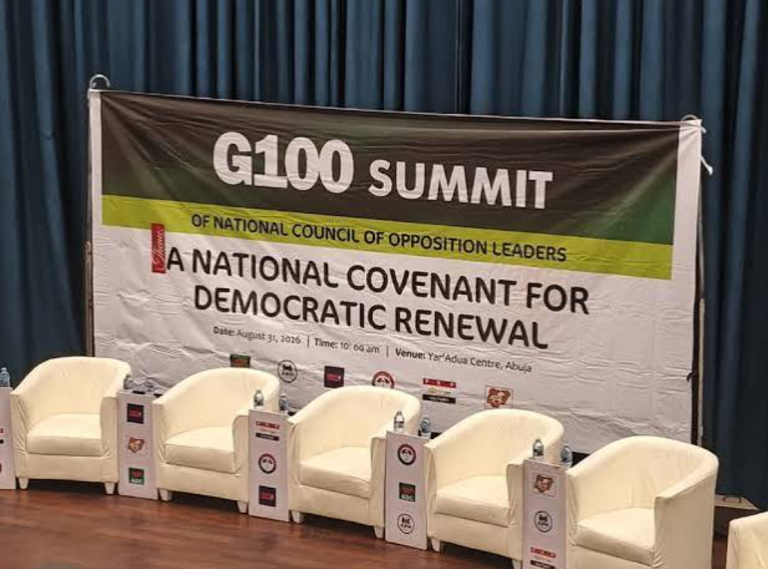
Plans by opposition parties to form a unified front for the 2027 general elections faced a major hurdle today, Monday in Abuja, as several prominent leaders boycotted the much-publicized summit.
The civil society group G100 and the House Minority Caucus hosted the summit at the Shehu Musa Yar’Adua Centre. They met to plan a unified presidential candidate and a four-year transition government.
However, the gathering was overshadowed by the absence of several key figures: Atiku Abubakar, Peter Obi, Rabiu Kwankwaso, and Rotimi Amaechi.
Party representatives gave no official explanation for the absence of the prominent opposition figures.
Despite the development, several opposition parties were represented at the summit, including the Social Democratic Party (SDP), Peoples Redemption Party (PRP), Democratic Leadership Alliance (DLA) and Allied Peoples Movement (APM).
Those in attendance included SDP presidential candidate Prince Adewole Adebayo and his running mate, Dr Usman Bugaje; PRP presidential candidate Donald Duke; DLA candidate Amb. Moses Olusola; and APM vice-presidential candidate Lawal Daura.
In his opening address, the Director-General of G100 and former Director-General of the Progressive Governors’ Forum, Salihu Mohd Lukman, warned that continued fragmentation among opposition parties could give the ruling All Progressives Congress (APC) an advantage in 2027.
Lukman said opposition parties had repeatedly contested presidential elections separately, allowing the ruling party to benefit from divided votes.
He urged the parties to focus on establishing rules for cooperation before debating individual candidates, proposing a Central Leadership Committee, five working groups and an enforceable four-year “National Covenant for Democratic Renewal”.
The House Minority Leader, Frederick Agbedi, also called for unity, saying political leaders should place the hardship facing Nigerians above personal ambitions.
“Nigeria is in pain. Nigeria is suffering. If we are united, we can repeat what the APC did in 2015. For us, there is no issue of a preferred candidate,” he said.
The National Vice-Chairman (South-South) of the ADC, Usani Uguru Usani, who led his party’s delegation, urged participants to work towards defeating the APC in 2027.
“This project is possible, and it is a case of now or never,” he said.
PRP National Chairman, Dr Hakeem Baba-Ahmed, said no single opposition party could defeat the APC alone, describing the coalition initiative as a “genuine sign of hope for Nigerians”.
Former Niger State Governor and PDP Board of Trustees member, Babangida Aliyu, urged the participants to sustain the process, lamenting that personal and pecuniary interests had taken precedence over national interest.
Aliyu also advised the organisers to extend the engagement to state and local government levels to ensure grassroots party members were included.
In a goodwill message, SDP National Chairman, Prof Sadiq Umar Gombe, said the political situation required an urgent national rescue effort, noting that opposition candidates collectively secured more than two-thirds of the votes cast in the 2023 presidential election.
Parties commit to coalition framework
Despite the absence of the major opposition figures, the participating parties formally committed to a structured negotiation process ahead of the 2027 elections.
The commitment was contained in a communiqué read by the spokesperson of the House Minority Caucus, Hon Afam Victor Ogene, after national chairmen and principal leaders of the six participating parties signed the document.
The parties agreed to establish three standing coalition organs: a Central Leadership Committee to serve as the political arbiter; a Publicity and Communication Committee to coordinate joint messaging; and a Legal Committee to draft the required constitutional and legal instruments.
They also established five working groups mandated to produce draft policy documents within 30 days. The areas include a National Covenant for Democratic Renewal, a Single-Term Transition Charter, a National Reform Programme, a Framework for Opposition Unity, and a Roadmap to a Common Presidential Candidate.
Ogene said the parties resolved to transcend narrow political interests and cooperate to address insecurity, rising living costs, and unemployment.
The communiqué stated that the G100 would remain a facilitator and observer in the process and would not substitute for the authority of the political parties.
The participating parties are expected to reconvene at a second summit to consider and formally adopt the frameworks produced by the working groups.


Cabotage Enforcement is My Priority: DG NIMASA

Customs Renovates Ife Girls’ School, Pledges University Scholarships

Tinubu Applauds Coca-Cola’s Planned $1b Investment

2027: Northern Muslim Women Declare Support for President Tinubu

Dakuku Peterside: Weak Institutions Stall Nigeria’s Wealth, Prosperity

Inside Nigeria’s Sea Power: The Rise of NPA as a Maritime Powerhouse

Adebayo Williams At 75: A Missing Honour — By Femi Macaulay

High Hopes as Dangote Launches ₦2.15 Trillion IPO

2027: LP chieftain sues WAEC, UNN, NYSC over Obi’s credentials

Tension in Osun as Masked Gunmen Kill Adeleke’s Ally ‘Emir’ at Peace Meeting

Tribute to a Colossus: The Eternal Legacy of Alhaji Bamanga Tukur (1935–2026)

US Praises Nigeria for Ending 12-Year Maritime Restrictions; Oyetola Credits President Tinubu

Environmental sanitation resumes in Lagos tomorrow

Tribute to a Legal Icon and Master Administrator: Alhaji Yahaya Bukar-Gana

Panel recommends 60-month timeline on State Police inauguration

Customs smashes smuggling ring at Tin-Can port, seizes illicit drugs worth ₦18.9b

Customs nets ₦178b at PTML, Miko resumes office

NIMASA Calls on The Media to Help Drive Blue Economy Growth

NIMASA Partners Malta to Fast-Track Full Automation of Nigerian Ship Registry

History as Customs CG Adeniyi bags First NIJ alumnus fellowship

“A Blueprint for Prosperity: How Amb. (Engr.) Omar Suleiman Will Transform Adamawa State”

Apapa Customs Intercepts ₦12.7b ‘Canadian Loud’, Expired Drugs in Lagos

Misclassified Levies: Senate Clears Customs of ₦62.2bn Under-Remittance Claim
