
Maritime
Oyetola Outlines New Maritime Commitments: Port Reforms, NPERA Act, Support for Shipowners

By Aminat Damilola, Assistant Editor
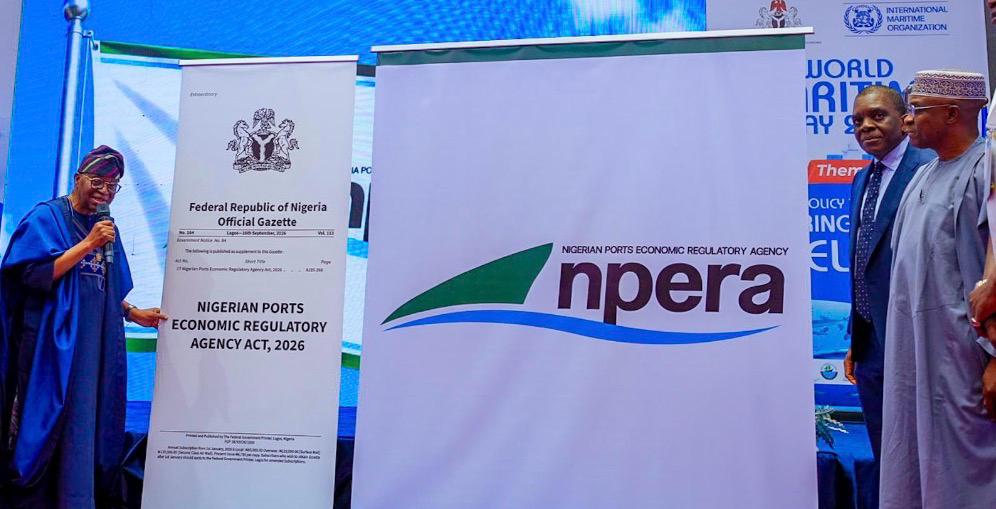
Minister of Marine and Blue Economy Dr. Adegboyega Oyetola has reaffirmed the Federal Government’s support for local shipowners while unveiling the newly gazetted Nigerian Ports Economic Regulatory Agency (NPERA) Act, 2026, and its official logo—describing it as a major step toward stronger port regulation, higher investor confidence, and greater maritime competitiveness
Speaking in Lagos today, he promised ongoing backing for Nigerian shipowners and the release of the Cabotage Vessel Financing Fund (CVFF) to qualified applicants.
The minister added that the enactment of the NPERA Act, following President Bola Ahmed Tinubu’s assent in June 2026, established a substantive statutory framework for port economic regulation after nearly two decades of efforts to institutionalise the function
Oyetola gave the assurance during the ministry’s Third Quarter 2026 Citizens’ and Stakeholders’ Engagement in Victoria Island, Lagos.
He emphasised that the administration remains committed to fully implementing the Cabotage Act, ensuring Nigerians can actively own and operate vessels in domestic maritime trade.
“To our indigenous shipowners, I wish to reaffirm this Administration’s commitment to the development of indigenous shipping capacity and the effective implementation of the Coastal and Inland Shipping (Cabotage) Act,” he said.
The minister said the administration remained committed to the effective implementation of the Coastal and Inland Shipping (Cabotage) Act to ensure that Nigerians participate fully in the ownership and operation of vessels engaged in domestic maritime trade.
“To our indigenous shipowners, I wish to reaffirm this Administration’s commitment to the development of indigenous shipping capacity and the effective implementation of the Coastal and Inland Shipping (Cabotage) Act,” he said.
As part of efforts to address longstanding concerns over access to financing, Oyetola disclosed that he had directed the Nigerian Maritime Administration and Safety Agency (NIMASA) to work closely with approved Primary Lending Institutions (PLIs) to accelerate the processing and disbursement of the CVFF to eligible beneficiaries.
“Progress may require patience, but our direction remains firm,” the minister stated, underscoring the administration’s determination to advance the fund’s implementation.
The CVFF is regarded as a critical financing instrument for supporting Nigerian shipowners and expanding indigenous participation in the maritime industry. Its effective deployment is expected to strengthen the national fleet and improve local capacity to compete in the domestic shipping market.
According to Oyetola, the benefits of the fund extend beyond vessel acquisition to other segments of the maritime value chain, including shipbuilding, marine engineering, vessel maintenance and maritime logistics.
He stressed that developing indigenous shipping capacity remained central to the government’s broader objective of ensuring that Nigerians derive greater economic benefits from the country’s maritime resources.
“The effective deployment of the CVFF has the potential to strengthen our indigenous fleet and stimulate investment across the maritime value chain,” he said.
The minister also highlighted the importance of professional training, local expertise development, support for indigenous businesses and strategic investment in building a competitive domestic maritime industry.
“Our ultimate objective is to build an industry in which Nigerians possess the opportunities, capabilities and resources to own, operate and lead,” he added.
Also, the minister said, the NPERA would be responsible for regulating tariffs and charges, promoting competition, enforcing service standards, resolving commercial disputes and protecting port users’ interests.
“The credibility of an economic regulator rests, in no small measure, on its independence, impartiality and freedom from responsibilities that could give rise to actual or perceived conflicts of interest,” Oyetola said.
He directed the agency to operate as an impartial arbiter, free from competing regulatory and operational responsibilities.
On port infrastructure, the minister highlighted plans to modernise Apapa, Tin Can Island, Onne, Rivers, Delta and Calabar ports, stressing that the programme would ensure balanced development across the country.
“No part of our national port system will be left behind in this modernisation programme,” he declared, adding that ports outside Lagos were equally important to Nigeria’s economic future.
He also disclosed that the Federal Government had approved the development of the Ibom, Bakassi, Agge, Gateway, Ondo and Bonny Deep Seaports to expand maritime capacity and strengthen Nigeria’s position as a regional logistics hub.
On maritime security, Oyetola said Nigeria had maintained zero piracy incidents in its territorial waters through the Deep Blue Project. He described the lifting of the 12-year United States Coast Guard Condition of Entry on vessels arriving from Nigeria in August 2026 as a major achievement.
The development, he said, reflected progress in maritime security and compliance with the International Ship and Port Facility Security Code.
The minister further reaffirmed the government’s commitment to indigenous shipping, disclosing that he had directed the Nigerian Maritime Administration and Safety Agency to work with approved Primary Lending Institutions to accelerate the processing and disbursement of the Cabotage Vessel Financing Fund to qualified applicants.
Emphasising international cooperation, the minister cited Nigeria’s election to Category C of the International Maritime Organization Council in November 2025 and ongoing engagements with Denmark, India, Norway and the United Kingdom.
“Our approach to international cooperation is purposeful and results-oriented,” he said, noting that partnerships must strengthen local capabilities and deliver measurable, sustainable outcomes.
The Ambassador, Embassy of the Kingdom of Denmark in Nigeria, Jens Ole Bach Hansen, did a presentation on Denmark’s Experience in Building a Sustainable Blue Economy: Lessons for Strategic Partnerships, Investment and Technology Transfer with Nigeria.”


LAGOS: Tinubu’s Maritime Policy, Performance to Take Center Stage at NNMJ Unity Conference

Hamzat Unveils 100-Point ‘Lagos Promise’ Manifesto, Pledges Better Quality of Life for Residents

President Tinubu Arrives in Jeddah for Umrah and National Prayers

Nigeria Customs, US Team Up to Fast-Track Trade

Naira Conversion Eroded $350m CVFF Value, Omatseye Reveals

Enugu Partners with Humatrix in Landmark BPO Deal to Create 100,000 Jobs

Boosting Maritime: Fed Govt, Banks Urged to Tackle Shipping Funding Crisis

NPA to Audit Inland Dry Ports, Partners With ICNL to Boost Hinterland Trade

President Tinubu Leaves for Mecca Tomorrow; Expected Back Next Week

Dockworkers may Shut Down Ports next week Over Terminal Operator Delays

Fed Govt seeks private sector funding blueprint as 30 state assemblies approve State Police

Ahead of 2027 Evaluation, Customs Vows Zero Tolerance for Money Laundering

Man Arrested in Adamawa While Trying to Sell His Niece for ₦7m

Customs smashes smuggling ring at Tin-Can port, seizes illicit drugs worth ₦18.9b

Environmental sanitation resumes in Lagos tomorrow

Apapa Customs Smashes Smuggling Ring, Seizes Illicit Drugs Worth ₦26.57b

IN 3 YEARS: Oyetola Reshapes Nigeria’s Blue Economy, Revenues Surge to ₦1.83tr

Customs CG Adeniyi Displays Narcotics, Fake Drugs Worth ₦53.3b at Apapa

SINGLE-DAY RECORD: Apapa Customs Generates ₦28b in 24 Hours

High Hopes as Dangote Launches ₦2.15 Trillion IPO

Oyo/Osun Customs Intercepts Rifles, Contraband Worth ₦3.2b in Three Months

Seme Customs Seizes 3,300 Explosive Cartridges, Generates ₦19.84b in 7 Months

Customs Zone ‘A’ Speeds Up Cargo Clearance to Hit ₦8trn Revenue Goal
