
Maritime
Center Equips Maritime Journalists with AI Tools to Enhance Professional Skills

Participants at the event in Lagos…Today
By Aminat Damilola, Assistant Editor
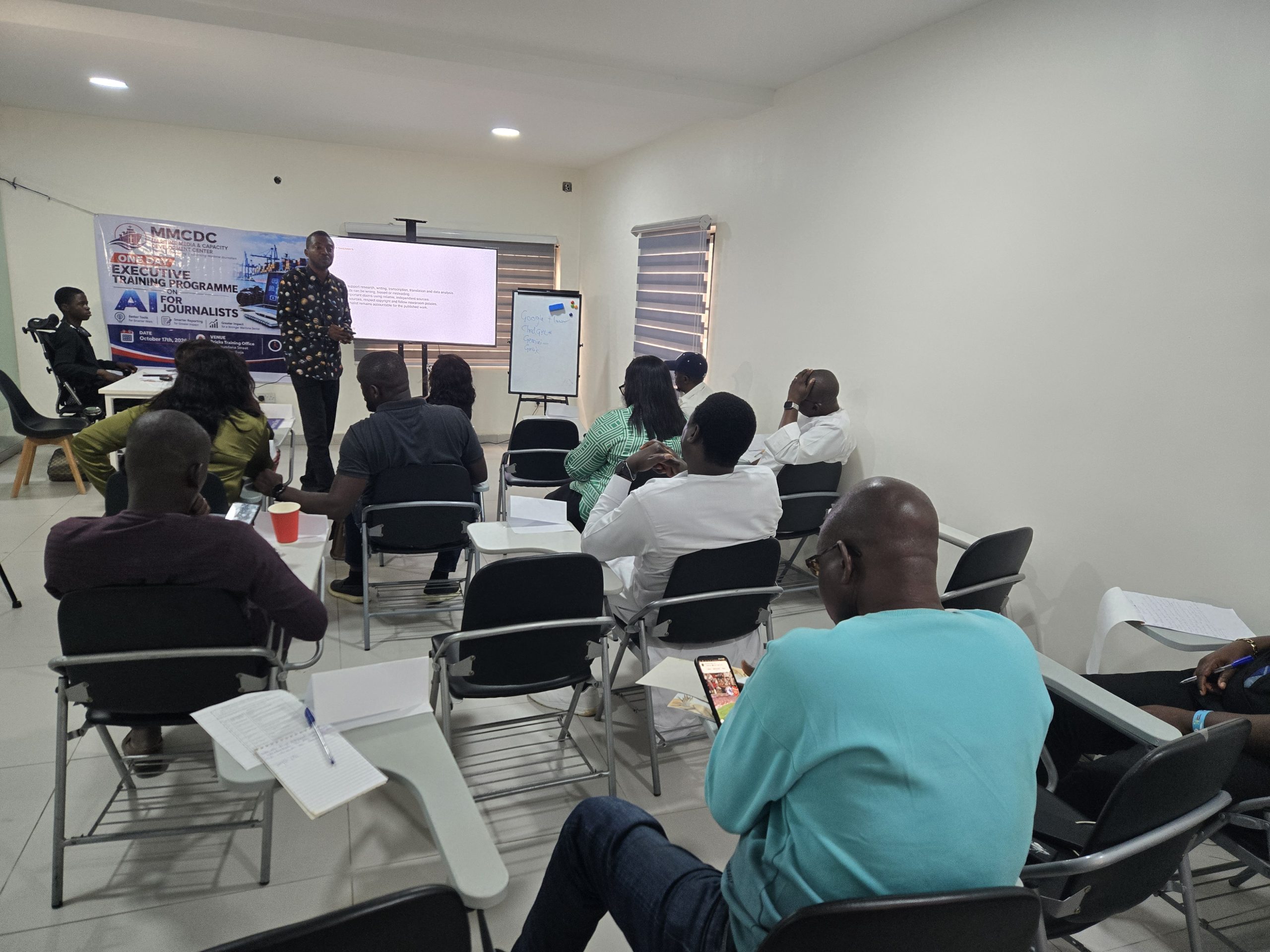
The Maritime Media and Capacity Development Center (MMCDC), a capacity enhancement arm of First Mediacon Network Limited, has organised a one-day executive training programme on Artificial Intelligence (AI) for some of the major maritime journalists in the country.
Addressing participants at the venue of the event in Lagos today, the Chairman of the Maritime Media and Capacity Development Centre (MMCDC) and Publisher of the Shipping Position Daily Newspaper, Mr. Sesan Onileimo, said the training programme and its initiatives were designed by the centre to help maritime journalists learn how to use AI tools to gather, verify, and write their stories perfectly in the newsrooms and beyond.
Maritime journalists, Onileimo said, cannot afford to remain spectators in a technological revolution that is reshaping the journalistic profession, as the future of journalism requires them to combine professional experience with technological competence, sound judgment, and ethical responsibility.
The training programme, he said, was taking place at a critical moment when technology is transforming the way news is gathered, processed, verified, and disseminated by professional journalists across the globe.
Verification and contextual review, he said, were critical to using AI tools. Onileimo added that no matter how advanced AI tools become, the journalist’s role as a gatekeeper of truth remains essential.
He emphasised the need for human oversight at every stage where AI is used to avoid libel based on errors, misleading interpretations. or fabricated details, and urged the participants to equip themselves to respond to these challenges.
While he agreed that “AI offers enormous opportunities,” he cautioned that “we must recognise its risks. These include misinformation, fabricated images, deepfakes, plagiarism, copyright concerns, and violations of data privacy.
His words: ” I am happy that you were all at that celebration, where I announced the birth and unveiling of the Maritime Media and Capacity Development Centre in December, 2025.
“Today’s event fulfills that promise. This training will usher-us into the 2026 edition of the Annual Seminar. This training programme is taking place at a critical moment when technology is transforming the way news is gathered, processed, verified and disseminated.
“Artificial Intelligence has become an important part of this transformation, creating new opportunities for journalists, while introducing challenges that require knowledge, skill and professional responsibility.”
As journalists, he said, “we must equip ourselves to respond to these changes. We cannot afford to remain spectators in a technological revolution that is reshaping our profession.
AI and the Changing Face of Journalism:
Artificial Intelligence, Onileimo said, “is already assisting journalists with research, transcription, translation, data analysis, content development and multimedia production.When properly applied, these tools can improve efficiency, save time and allow journalists to concentrate on investigative reporting, critical analysis and public-interest journalism.
“However, AI is just a tool. It is not a replacement for the journalist or journalism. Yes, AI can generate information quickly, but that information may contain errors, misleading interpretations or fabricated details. It is therefore expected that journalists must verify AI-generated content before publication.
“Even as we rely on these tools, we must remain commitment to truth, accuracy, fairness and accountability.”
The Importance of AI to Maritime Journalism:
Highlighting the relevance of the training and its significant for maritime journalists, the publisher of the Shipping Position newspaper, said the nation’s maritime industry plays a strategic role in international trade, port operations, shipping, logistics, employment and economic development and that reporting these activities “requires specialised knowledge and the ability to interpret complex technical, regulatory and economic issues.
“For instance, when reporting on port performance, journalists may need to examine cargo throughput, vessel turnaround time, operational costs and other indicators. AI can assist in organising and analysing such information, while journalists verify these figures and provide the necessary context for an interesting and fact-based report.”
These capabilities, he added, “can encourage more analytical, evidence-based and investigative reporting on Nigeria’s maritime sector. Nevertheless, the credibility of our reports must never depend solely on information generated by AI.
“Official records, reliable documents and independent sources, remain essential to responsible journalism.”
Ethical Challenges and Professional Responsibility:
While he aggred that “AI offers enormous opportunities,” he cautioned that “we must recognise its risks. These include: misinformation, fabricated images, deepfakes, plagiarism, copyright concerns and violations of data privacy. The ability of AI to produce convincing yet inaccurate information makes verification more important than ever.
Onileimo therefore, advised journalists to always confirm claims, check original sources and independently verify images, audio recordings and videos before using them for publication.
“We must also exercise caution when uploading confidential documents, unpublished investigations or sensitive information about our sources to AI platforms. In the end, you have editorial accountability of integrity. This must be based on sound judgement. AI must serve journalism; it must never replace our conscience, independence or responsibility to the public.Remember, whatever you put out in the public domain carries your byline.
“We must ensure that technological advancement strengthens societal trust in our profession. We must not allow AI or unverified attributions or sources to undermine this trust,” he warned.
Building Capacity for the Future:
“As Chairman of the Maritime Media and Capacity Development Centre, I believe that continuous professional development is essential to the growth and sustainability of maritime journalism.
“Media organisations, professional associations and training institutions must therefore work together to prepare journalists for emerging technological demands. In the light of this, I therefore call on corporate organisations to partner with the Maritime Media and Capacity Development Centre to advance this course.”
Onileimo stated that the Executive Training Programme was part of the Corporate Social Responsibility (CSR) initiatives of our parent company – First Mediacom Network Limited.
He thanked his friend. Mr Emmanuel Maiguwa, the CEO of Brooks Training Institute, for availing the Centre “use of this cozy facilities, at no cost to us.”
Mr. Adebayo Babatunde, CEO of Dells Prints, led the journalists through practical sessions and outlined the training’s core objectives.
According to him: “The purpose of this training today is to let journalists know how AI can enhance their productivity in the area of news writing, in the area of giving the public the right news, and not compromising accuracy, not compromising genuineness, not compromising the truth, and how they can use AI to create newsroom videos that can entice the public to their page or to their media house in order to gain more followership,” Bavatunde said


Hamzat Unveils 100-Point ‘Lagos Promise’ Manifesto, Pledges Better Quality of Life for Residents

President Tinubu Arrives in Jeddah for Umrah and National Prayers

Nigeria Customs, US Team Up to Fast-Track Trade

Naira Conversion Eroded $350m CVFF Value, Omatseye Reveals

Enugu Partners with Humatrix in Landmark BPO Deal to Create 100,000 Jobs

Boosting Maritime: Fed Govt, Banks Urged to Tackle Shipping Funding Crisis

NPA to Audit Inland Dry Ports, Partners With ICNL to Boost Hinterland Trade

President Tinubu Leaves for Mecca Tomorrow; Expected Back Next Week

Dockworkers may Shut Down Ports next week Over Terminal Operator Delays

Fed Govt seeks private sector funding blueprint as 30 state assemblies approve State Police

Ahead of 2027 Evaluation, Customs Vows Zero Tolerance for Money Laundering

JUSTIN: Panel Reveals 37 Miners Suffocated in NSCDC Custody

Man Arrested in Adamawa While Trying to Sell His Niece for ₦7m

Customs smashes smuggling ring at Tin-Can port, seizes illicit drugs worth ₦18.9b

Environmental sanitation resumes in Lagos tomorrow

Apapa Customs Smashes Smuggling Ring, Seizes Illicit Drugs Worth ₦26.57b

IN 3 YEARS: Oyetola Reshapes Nigeria’s Blue Economy, Revenues Surge to ₦1.83tr

Customs CG Adeniyi Displays Narcotics, Fake Drugs Worth ₦53.3b at Apapa

SINGLE-DAY RECORD: Apapa Customs Generates ₦28b in 24 Hours

High Hopes as Dangote Launches ₦2.15 Trillion IPO

Oyo/Osun Customs Intercepts Rifles, Contraband Worth ₦3.2b in Three Months

Seme Customs Seizes 3,300 Explosive Cartridges, Generates ₦19.84b in 7 Months

Customs Zone ‘A’ Speeds Up Cargo Clearance to Hit ₦8trn Revenue Goal
