
Education
UI Celebrates CGC Adeniyi’s Lecture on Customs Reform and the ‘Borderless World’ Myth

By Aminat Damilola, Assistant Editor
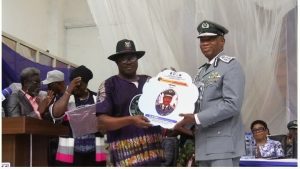
The University of Ibadan has formally honoured the Comptroller-General of the Nigeria Customs Service (CGC), Dr. Bashir Adewale Adeniyi for his insightful lecture on the myth of a borderless world and the reforms being carried out by the Federal Government through his management team, Spynews reports.
The CGC, it was gathered, was given the prestigious honour after delivering a flawless lecture—at the 3rd Distinguished Personality Lecture themed, ‘Why Customs Matters: Revenue, Security and Nationhood in a Borderless World,’ at Trenchard Hall of the premier university.
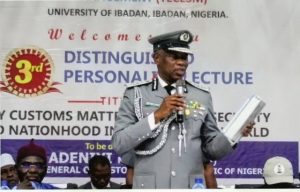
The event was organised by the TETFund Centre of Excellence in Security Management (TECESM), University of Ibadan, Oyo State.
In his welcome address, the TECESM Director Prof. P. A Aluko gave the reasons for organising the lecture and for choosing the CGC to deliver it
Also, Prof. Abel Idowu Olayinka (the 12th U.I. Vice-Chancellor) was the Chairman of the Occasion.
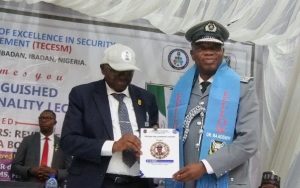
The Vice-Chancellor, Prof. Kayode Oyebode Adebowale, was the Chief Host. He praised the CGC’s distinguished milestone accomplishments.
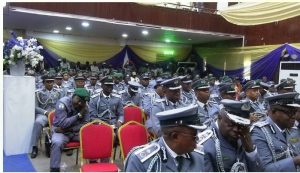
Speaking to a packed hall of professors from diverse academic faculties, Adeniyi first shared a striking example of modern border security: the case of the MV Velika ship that called at Lagos’s Tin Can Island Port.
To the untrained eye, the CGC said, the ship was discharging standard containers like any other vessel. Yet, a risk-management flag led officers of the Service to discover 399 pump-action rifles and hundreds of disassembled firearm components hidden inside—all intended to carry out a dastardly act within the country.
But that discovery, Adeniyi added, “came from a system (the administration of President Bola Ahmed Tinubu chose to invest in reform), not from luck. The weapons are now with the National Centre for Control of Small Arms and Light Weapons, and because suspects are before the Federal High Court,” the CGC said he decided not to say anything more about the case for proper adjudication.
The second example he gave to illustrate the myth of a borderless world took place at the Idiroko border, where a market woman had been crossing between Ogun State and the Republic of Benin with fabric and seasoning cubes for 20 years. Because her cousins live on the other side and speak the same Yoruba she speaks, Adeniyi said, to her, “the border is a line on somebody else’s map,” unnecessarily preventing her from doing her business.
Finally, the CGC gave an example of how revenue generated by the Federal Government through the Service is channeled: a young woman in a TETFund laboratory at a state university may never have seen a seaport, yet part of what pays her lecturers reaches her State Government each month from the Federation Account. Some of that money, Adeniyi said, “was collected by a Customs officer at Apapa, Onne, or Tin Can Island Ports” to boost learning and promote education across the country.
The container, the market woman, and the student, Adeniyi said, “are three faces of one institution. The container speaks of security and the student speaks of revenue. The market woman speaks of nationhood: where Nigeria ends, where its neighbours begin, and how gently or harshly the state touches its citizens at that line.”
His title for the lecture, the CGC said, “adds a fourth idea: a borderless world. For more than three decades, we have been told that borders are fading, and money now moves at the speed of light. A phone in Bodija can order goods from a warehouse in Guangzhou. From this, some conclude that Customs, the oldest gatekeeper of the state, is a relic awaiting retirement.
“My argument this morning is the opposite. Customs matters more in a connected world, not less, because the connection is real but the borderlessness is a myth. The institution that manages the convergence of trade, revenue, and security at Nigeria’s frontier is the Nigeria Customs Service,” Adeniyi declared.
The CGC began his lecture with a brief history of customs, from ancient Athens to Apapa, and then turned to the story of the Nigeria Customs Service.
He examined the three pillars of his title: revenue, security, and nationhood. He then addressed the myth of the borderless world and the reforms they are building in response to the challenges. Adeniyi ended with a call to the University because the next phase of reform by the Service, according to him, “needs scholars as much as it needs officers” to carry out its core responsibilities.
THE LECTURE: A BRIEF HISTORY OF CUSTOMS FROM THE PIRAEUS TO APAPA
Customs is as old as trade itself. Wherever goods crossed from one authority to another, someone stood at the crossing to count them, tax them and, when necessary, stop them. In ancient Athens, around 400 BC, the city charged 2 per cent on goods passing through its port, the Piraeus, and auctioned the right to collect it. When the orator Andocides outbid the previous collector by 6 talents, he exposed how much had been slipping into private pockets. Revenue leakage at the port, ladies and gentlemen, is a problem at least 2,400 years old. Even the word “tariff” carries a lesson: it comes from the Arabic ta’rif, a notification, from a root meaning ‘to make known. At root, a tariff is the state making known what is due.
History has also given us some unlikely customs officers. Geoffrey Chaucer, the father of English poetry, spent about 12 years as Controller of customs at the Port of London, keeping the ledgers in his own hand. Adam Smith, the great prophet of free trade, became Commissioner of Customs for Scotland in 1778, two years after The Wealth of Nations. The poet kept the books and the free trader administered the duties. Even the most principled advocate of open markets understood that a state must manage its frontier.
Our own soil has an older customs story than many realise Long before any British department, the kings of the Niger Delta charged European ships a duty called comey, about two shillings and sixpence per ton of palm oil. In return, the kings guaranteed the traders’ safety and kept the trade routes open. Look closely at that bargain: a duty paid in exchange for security and order. That is the very pairing in my title, practised on our coast before anyone had coined the name “Nigeria”. In the north, Kanem-Bornu drew revenue from the caravans that linked Lake Chad to Tripoli, on the same understanding that safe roads and steady trade go together.
The lesson is plain. Customs in Nigeria was not invented by the colonial state; it was inherited from indigenous systems and then taken over. When the Oil Rivers Protectorate was formed in 1891, the British took the collection of comey from the Delta kings and replaced it with import duties. That is the year from which the Nigeria Customs Service dates its founding, and it is where our own story begins.
THE NIGERIA CUSTOMS SERVICE 135 YEARS OF SERVICE
In 1891 the colonial administration appointed T. A. Wall as the first head of customs on the Niger coast. His task was to collect duty at a string of river ports reached mostly by water. That revenue was everything. In 1898-99, customs supplied about 95 per cent of the Niger Coast Protectorate’s revenue, and duties on wine, beer and spirits alone supplied about 78 per cent. In fiscal terms, the early colonial state in southern Nigeria was a customs house with a flag on it. Customs also produced our first quarrel over revenue allocation. Around 1900, Frederick Lugard, later Lord Lugard, claimed £34,000 of southern customs revenue for the North, and Ralph Moor offered £15,000. Our monthly debates at the Federation Account Allocation Committee have a long pedigree, and they began with customs.
The institution grew in stages. The Department of Customs and Excise took shape in 1922, and a Preventive Service was added in 1945 The Customs and Excise Management Act of 1958 placed the Department under a Board. In 1964, Ayodele Diyan became the first Nigerian to head it, and some argue that this is the true birth of a Nigerian customs service. I welcome that debate. The colonial department came first, but the Nigerian institution was built afterwards, by Nigerians, for Nigeria. The revenue and enforcement arms were unified in 1977. Dr Bello Haliru Mohammed became the first Comptroller-General in 1988, and in 1992 we became the Nigeria Customs Service, a paramilitary organisation.
The most important legal step came on 20 April 2023, when President Muhammadu Buhari signed the Nigeria Customs Service Act 2023. It repealed the 1958 Act and gave us a new legal foundation for the first time in 65 years. I shall return later to what the Act now allows us to do.
Customs is also a global profession. The Customs Co-operation Council met for the first time in Brussels on 26 January 1953, a date now marked every year as International Customs Day. Today, as the World Customs Organization, it brings together 187 administrations that handle about 98 per cent of world trade. In June 2025, I was elected Chairperson of the WCO Council, and in June this year the Council returned me for a second term. I mention this not for personal credit, but because Nigeria now sits at the table where the rules of global customs are written. A seat at that table carries a duty to contribute, and it has opened a path our officers had not walked before. Two officers of the Service now serve as Technical Attachés at the WCO Secretariat in Brussels. A third supports the WCO Regional Office for Capacity Building for West and Central Africa in Abidjan. They go not as guests of the profession, but as contributors to it, and they will return with experience that no classroom alone can give.
WHY CUSTOMS MATTERS (I): REVENUE
From that global table, let me bring us home to the student in her laboratory. What links her to a container at Apapa is the Federation Account. Import duty goes into that Account and is distributed by the statutory formula: 52.68 per cent to the Federal Government, 26.72 per cent to the states and 20.60 per cent to local governments. Put simply, about 47 kobo of every naira goes to states and councils. Since January this year, under the new tax laws, 90 kobo of every naira of the VAT we collect on imports also goes to states and councils. Those councils pay for primary schools, primary health care and rural roads. A duty paid at Apapa can end up repairing a classroom in Ibadan North. So when a smuggler evades duty, he does not cheat an abstraction called government. He cheats a pupil, a nurse and a farmer.
Consider the numbers. The Service collected about N3.2 trillion in 2023, N6.105 trillion in 2024 and N7.28 trillion in 2025, against a target of N6.58 trillion. Some have attributed this growth to the exchange rate alone. Currency adjustment played its part, since duty assessed in naira. But exchange rates do not catch undervaluation close leakages or clear compliant traders faster. Better valuation sharper risk management, digital platforms and tighter enforcement did that work. Our officers earned these figures.
The better test is 2025, when the exchange rate was steadier. Revenue still grew by about 19 per cent and beat its target. Firms certified under our Authorised Economic Operator programme raised their revenue contribution by about 30 per cent. That is growth from compliance and better systems, and it is the growth we want. Our 2026 target of N11.07 trillion is demanding. We collected about N4.03 trillion in the first half, while tensions in the Middle East slowed cargo. We will pursue the target through compliance, data and facilitation, not through harassment at the ports, because a target met by choking trade would be a false victory.
Customs revenue matters more in developing economies than in rich ones. In 2023, Africa’s average tax-to-GDP ratio was 16.1 per cent, against 33.9 per cent in the OECD. Large informal sectors make income tax hard to collect. Imports, by contrast, pass through a few points we can watch: seaports, airports and border posts. This is why trade integration must be pursued with our eyes open, since many countries that cut trade taxes never replaced the lost revenue. It is also why waivers deserve scrutiny. Import concessions were worth about N1.68 trillion in 2024, and in August I called for a review of the waiver regime alongside the Customs Act.
Then there is money that leaves through false invoices. The panel chaired by former President Thabo Mbeki estimated that Africa loses at least US$50 billion a year in illicit financial flows, and UNCTAD later put the figure at about US$88.6 billion. Underpricing and over invoicing of goods are among the main channels. Every under-declared Invoice is a small act of fiscal theft, and customs valuation is the front line against it. Revenue, then, is he material base of the social contract and not just money. A nation that cannot fund itself cannot govern itself. That is the first reason Customs matters.
WHY CUSTOMS MATTERS (II): SECURITY
Now return to the container. The Velika case was not the first of its kind. On 21 June 2024, our officers intercepted 844 rifles and 112,500 rounds of ammunition at a bonded terminal in Onne. They came in a 40-foot container from Türkiye, hidden among dolls, furniture and plumbing fittings. In February 2025, we handed over 1,599 firearms seized between 2018 and 2024 to the National Centre for the Control of Small Arms and Light Weapons. A pattern emerges: the large consignments came by sea, in containers, dismantled or hidden among household goods. This is security performed upstream. Every rifle stopped at the quay is a rifle that never reaches a forest camp, a kidnapping gang or a polling unit. As the 2027 general elections approach, that vigilance matters even more. I will also be honest about a gap: our largest arms seizures have come through seaports, not across the land borders of the Sahel. That tells us where detection must improve, and I invite this Centre to help us study it.
Threats to security do not always carry a trigger. In July 2025, we seized 25 containers of fake and unregistered medicines worth about N9.2 billion, including antimalarials and antibiotics with false NAFDAC numbers. Imagine a mother in Ogbomoso buying an antimalarial for a feverish child. She cannot test the tablet; she trusts the pack. If that pack is false, the fever does not break. This is why I call counterfeit medicine a threat to national health security, and the border is where it can be stopped in bulk. Drugs of abuse follow the same logic. In August this year the NDLEA intercepted more than 47,000 Captagon pills hidden in blocks of soap at Lagos airport. Days later, a joint examination by our officers and the NDLEA at the same airport uncovered millions of opioid tablets.
Traffickers have also tried to use our ports as a route to East Asia for wildlife. In April 2025, working with the Wildlife Justice Commission, we seized 3.76 tonnes of pangolin scales in Lagos, at least 1,900 dead animals. Since 2021, these joint operations have seized more than 25 tonnes of scales and over a tonne of ivory, with 12 convictions. We intend to make Nigeria a dead end for this trade, not a transit route. Fuel and food tell a related story. Under Operation Whirlwind, our officers seized about a quarter of a million litres of petrol in under three months in early 2025. By March 2024, while enforcing restrictions on the export of essential food items under the food-security emergency, we had seized more than 120 trucks of food. These are not mere economic offences. The UN Office on Drugs and Crime has reported that fuel smuggled from Nigeria is likely to supply violent extremist groups in the Sahel, and that such groups tax the trade where they hold ground.
The regional setting has grown harder. After the coup in Niger in July 2023, Nigeria closed that border until March 2024. In January 2025, Burkina Faso, Mali and Niger left ECOWAS and have since imposed their own levy on imports from outside their confederation. Our long northern frontier now faces a separate bloc. The global picture is similar. The WCO’s Illicit Trade Report for 2025 recorded 163,850 cases from 170 administrations, almost 45 per cent of them linked to e-commerce. Scholars will rightly note that seizure data partly measure enforcement effort, not only crime, and that caveat is fair.
For students of security, Customs fits two familiar frames. In the language of securitisation, we move certain flows, such as arms, fake medicine and wildlife, out of ordinary trade and into the domain of threat. In the language of human security, we protect both freedom from fear and freedom from want. Yet Customs does not act alone; we are the detection point in a chain of custody. Seized arms go to the Small Arms Centre, drugs to the NDLEA, fake medicines to NAFDAC and undeclared cash to the EFCC. In 2025 alone, our officers intercepted more than US$1.7 million in undeclared currency at airports and land borders. Security, then, is the second reason Customs matters. The border is not a wall; it is a filter. The quality of that filter decides what reaches our streets, our pharmacies and our forests.
WHY CUSTOMS MATTERS (III): NATIONHOOD
Now return to the market woman at Idiroko. The scholar Benedict Anderson described the nation as an “imagined community”: most citizens will never meet, yet each carries an image of belonging together. Anderson showed how maps, the census and the museum help the state make that image real. I would add the Customs post to his list. For many visitors, the officer at Seme, Idiroko or the Lagos airport is the first face of Nigeria, and for a departing trader he is the last. What that officer does, with courtesy or with contempt, teaches people what Nigeria is.
Our borders were drawn by colonial negotiators who never consulted the people living along them. The line through Idiroko runs through Yoruba communities, and the line through Illela and Jibia runs through Hausa communities. Kinship crosses those lines every day, so Customs must enforce the law without declaring war on kinship. That is why the ECOWAS Trade Liberalisation Scheme matters, because it gives small traders a legal channel for goods of community origin. Our task is to make that channel easy enough that the market woman prefers it to the bush path. A border that only punishes will be evaded; a border that also serves will be used.
Experience has taught us this. The land border closure of August 2019 to December 2020 curbed some smuggling, but field research published this year found that the closure did not destroy the smuggling networks; it reorganised them. The lesson is that a nation is protected by intelligent control of its border, not by sealing it. Closure is a blunt instrument, while intelligence, data and joint patrols with our neighbours are sharper ones.
Consider the bag of smuggled rice. Between August and September this year, our Ogun I Command seized 1,204 bags of foreign parboiled rice. That bag carries more than grain. It evades duty that would have reached the Federation Account and undercuts a farmer in Kebbi who borrowed to plant. It may be expired or unsafe, and it rewards a smuggler who may move fuel or worse along the same route. Yet nationhood also demands hard choices between citizens. In July 2024, government suspended duties on some food imports for 150 days to ease food inflation. Consumers and producers are both Nigerians, and Customs administers whatever balance the nation chooses between them.
Nationhood is also fiscal. The colonial customs house funded a foreign administration, but today customs revenue funds a federation of our own. A country that collects its own revenue, at its own borders and under its own laws, is exercising sovereignty in its most practical form. That sovereignty now reaches beyond our shores. In August, the AfCFTA Secretary-General described our B’Odogwu clearance platform as a model for Africa. Nigeria is not following the continent; it is helping to lead it. That is the third reason Customs matters: it gives the imagined community a real and dignified threshold.
THE MYTH OF THE BORDERLESS WORLD
Let me now address the fourth idea in my title. In 1990, the Japanese strategist Kenichi Ohmae published The Borderless World, arguing that national borders were becoming obstacles to prosperity. About 15 years later, Thomas Friedman declared the world “flat”, levelled by computers, fibre-optic cables and global supply chains. To many, the customs officer began to look like a man guarding a gate in a field without fences. The evidence has not been kind to that thesis. The scholar Pankaj Ghemawat estimated that the world is only about 10 to 20 per cent globalised, since most trade, investment and communication remain domestic. The DHL Global Connectedness Report of 2026 found that global goods trade grew faster in 2025 than in any year since 2017, and travelled longer distances than ever recorded. Its verdict: the world is not disconnecting; its connections are changing. The world is connected, but it is not borderless.
Indeed, the past 2 years have brought a dramatic re-bordering. In April 2025, the United States imposed sweeping new tariffs. In February 2026, its Supreme Court ruled that the emergency law used for many of them did not authorise them. Refunds, replacement tariffs and appeals all ran through one machinery: customs. E-commerce, once expected to make borders irrelevant, has brought them back. The United States suspended duty-free treatment for low-value parcels from all countries in August 2025. The European Union began charging €3 per item category in small parcels in July this year. In March, at the WTO Ministerial Conference in Yaoundé, the moratorium on customs duties for electronic transmissions lapsed.
Why does this keep happening? The economist Dani Rodrik offers a clear answer. A country cannot fully have deep global integration, national sovereignty and democratic politics all at once; it must give up some of one to keep the others. Every tariff line, every low-value threshold and every rule of origin is that choice made concrete. Customs is where the choice is administered.
Africa’s own integration proves the point. The African Continental Free Trade Area now has 50 State Parties, yet it does not abolish borders. It changes what Customs does at them: we certify origin, apply preferential tariffs and connect our systems with those of our neighbours. Without Customs, the AfCFTA would remain a treaty on paper. For Nigeria, the opportunity is clear. Imports from other African countries were only about 4 per cent of our total imports in 2025. Freer African trade should therefore cost us little in import duty while opening wider markets for our producers.
In Brussels in June this year, I compared our work to the just concluded football World Cup tournament hosted across several countries. Every match must start on time, but every gate must be checked. I said then that speed without control will result in chaos, and I say it again here. Facilitation and control are not opposites; they are partners. So the borderless world is a myth. What we have is a connected world with smarter borders. The real question is whether those borders will be intelligent, fair and fast, or slow, corrupt and blind.
THE CUSTOMS WE ARE BUILDING
Let me now describe the Customs we are building to meet that test. Its foundation is the Nigeria Customs Service Act 2023. The Act provides for advance rulings on classification, valuation and origin, so traders know their obligations before goods arrive. It adopts transaction value as the basis of valuation, provides for post-clearance audit and enables mutual assistance with foreign customs administrations. It also gives the Service a stable source of funding: 4 per cent of the free-on-board value of imports, collected since 4 August 2025. A customs service that is properly funded can invest in scanners, systems and people instead of depending on fragile contracts.
On that foundation we are building a digital backbone. B’Odogwu, our home-grown clearance platform, processed about 16,000 entries and N120 billion in revenue in its first three months at the PTML Command, without downtime. It is now fully operational, it was built by Nigerians, and it is being integrated with the National Single Window. The Single Window went live on 27 March 2026. It brings import permits, manifests and risk management onto one platform, and exports and full declarations are being added in phases. Our long-term goal is clearance within 24 hours.
We are also measuring ourselves honestly. With WCO support, we conducted a Time Release Study at Tin Can Island Port and launched its report on International Customs Day this year. Average release time was nearly 5 days, yet physical inspection took only hours, and more than 90 per cent of the time was spent waiting. Our problem is not inspection; it is idle time. So we have set clear goals: release within 2 days, and scanning instead of physical examination for 99 per cent of cargo. We are also rewarding compliance. Under the Authorised Economic Operator programme, launched in February 2025, 51 certified firms have seen clearance time fall from 168 hours to 41, and demurrage fall by about 90 per cent. Trust, properly verified, pays both the trader and the treasury.
Data is the next frontier. Working with the WCO, customs administrations are now using machine-learning models to detect undervalued declarations and recommend tariff classifications. Our own risk-management system, the one that flagged the Velika container, belongs to this new generation of data-driven customs. The officer of the future will spend less time opening boxes and more time reading patterns.
Yet systems do not seize containers; officers do. Nor can any system stop an officer who chooses to look away. We are therefore strengthening training through the Command and Staff College, rewarding integrity and dealing firmly with collusion, because one compromised insider can undo the work of a thousand honest officers. We also work in partnership with the Navy, the NDLEA, NAFDAC, the EFCC and the Office of the National Security Adviser. With our neighbours and ECOWAS, we have upgraded the Seme-Krake Joint Border Post, and through the WCO Council we help shape global standards.
I will not claim that the work is finished. Clearance times are still too long, waivers still need discipline, and some officers still fall short of our standards. But the direction is clear and the progress is measurable. That is precisely why I now turn to you.
A CALL TO THE ACADEMY
Mr Chairman, the Customs Service generates data every second, and universities generate understanding. Too often the two have lived apart, so let me propose five practical ways for TECESM, the University of Ibadan and TETFund to work with the Service. The first is a Border Economies Research Partnership. Let us send researchers to Idiroko, Seme, Jibia and Illela to learn who trades, what they trade, what compliance costs them and why they choose the bush path. That evidence will help us design legal channels for small traders that actually work. The second is a set of Customs Data and Analytics Fellowships, funded through TETFund research grants. Doctoral and post-doctoral fellows would work with our risk-management teams on properly anonymised data, under strict confidentiality rules. Together, we would build and test models against valuation fraud, misclassification and smuggling.
The third is an Illicit Trade Observatory hosted at this Centre.The WCO publishes global data, but West Africa needs its own lens on the flows of arms, drugs, fake medicines, wildlife and fuel across our region. An annual report from such an observatory would inform policy-makers, security agencies and the public. The fourth is a postgraduate curriculum on borders, trade and illicit flows. Our officers could enrol as students, our senior officers could teach as practitioners, and our Command and Staff College could become a sister institution of this Centre. The fifth is independent evaluation. I invite scholars to study our reforms critically, from the Customs Act and the waiver regime to the AEO programme and the Single Window. A reform that is never evaluated cannot be improved, and I would sooner hear hard truths from Ibadan than discover them too late in the field.
I will ask my team to engage the Director of TECESM on scoping and prioritising these proposals. Some will take time, but all are worth starting. This University has always taught Nigeria to understand itself. Its historians helped us see our past, and its economists helped us read our economy. I now ask you to help us understand our border, because that is where the nation meets the world.
CONCLUSION
Let me return, in closing, to the 3 people with whom I began. The containers at Tin Can and Onne remind us that Customs is a security institution. Our officers stand between the arms dealer and the polling unit, between the counterfeiter and the sick child, and between the trafficker and the forest. The student in her laboratory reminds us that Customs is a revenue institution. Every naira lawfully collected at our ports can reach her classroom, her clinic and her road, and every naira evaded is stolen from her future. The market woman at Idiroko reminds us that Customs is an institution of nationhood. We are the threshold of the Nigerian state, and how we treat her, firmly but fairly, tells her and the world what kind of nation Nigeria intends to be.
The world is not borderless. It is connected, and that connection makes the border more important, not less. The Delta kings who collected comey understood the bargain of duty in exchange for order, and Athens learned that collection must be honest. Our task is to keep that bargain in a digital age, through data, integrity and partnership. Customs, at its root, is the state making known what is due: what must be paid, what must be stopped and who belongs. That is why Customs matters, and that is why I am grateful to stand in front of this academy and ask you to help us do it better.
Thank you for listening
Paper Delivered by CG Customs
Dr. Bashir Adewale Adeniyi at the
University of Ibadan
On Tuesday, 20th October, 2026


LAGOS: Tinubu’s Maritime Policy, Performance to Take Center Stage at NNMJ Unity Conference

Hamzat Unveils 100-Point ‘Lagos Promise’ Manifesto, Pledges Better Quality of Life for Residents

President Tinubu Arrives in Jeddah for Umrah and National Prayers

Nigeria Customs, US Team Up to Fast-Track Trade

Naira Conversion Eroded $350m CVFF Value, Omatseye Reveals

Enugu Partners with Humatrix in Landmark BPO Deal to Create 100,000 Jobs

Boosting Maritime: Fed Govt, Banks Urged to Tackle Shipping Funding Crisis

NPA to Audit Inland Dry Ports, Partners With ICNL to Boost Hinterland Trade

President Tinubu Leaves for Mecca Tomorrow; Expected Back Next Week

Dockworkers may Shut Down Ports next week Over Terminal Operator Delays

Fed Govt seeks private sector funding blueprint as 30 state assemblies approve State Police

Ahead of 2027 Evaluation, Customs Vows Zero Tolerance for Money Laundering

Man Arrested in Adamawa While Trying to Sell His Niece for ₦7m

Customs smashes smuggling ring at Tin-Can port, seizes illicit drugs worth ₦18.9b

Environmental sanitation resumes in Lagos tomorrow

Apapa Customs Smashes Smuggling Ring, Seizes Illicit Drugs Worth ₦26.57b

IN 3 YEARS: Oyetola Reshapes Nigeria’s Blue Economy, Revenues Surge to ₦1.83tr

Customs CG Adeniyi Displays Narcotics, Fake Drugs Worth ₦53.3b at Apapa

SINGLE-DAY RECORD: Apapa Customs Generates ₦28b in 24 Hours

High Hopes as Dangote Launches ₦2.15 Trillion IPO

Oyo/Osun Customs Intercepts Rifles, Contraband Worth ₦3.2b in Three Months

Seme Customs Seizes 3,300 Explosive Cartridges, Generates ₦19.84b in 7 Months

Customs Zone ‘A’ Speeds Up Cargo Clearance to Hit ₦8trn Revenue Goal
