
Politics
The Legacy of Gani Fawehinmi: Where Nigeria Stands 17 Years Later

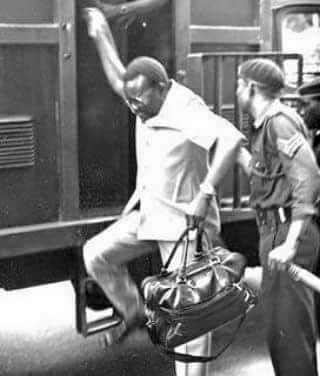
PHOTO: Chief Gani Fawehinmi arrested by the military government
By Saheed Olatunji, Reporter
Rights activists, labor leaders, and civil society groups demand urgent reforms to fix insecurity, economic hardship, and threats to Nigeria’s democracy.
They made the call at the weekend during 17th Gani Fawehinmi Memorial Lecture and Civil Justice Legacy Project in Ikeja.
The lecture had the theme: “Democracy, Human Dignity and the Nigerian State: Living Wage, Security and Accountability in the Public Interest.”
Participants at the event emphasized the importance of continuing Chief Gani Fawehinmi’s lifelong struggle for justice, accountability, and the protection of the oppressed.
Dr. Joe Okei-Odumakin, President of the Centre for Change and chairperson of the occasion, described the late activist as a selfless defender of the vulnerable whose legacy must be preserved.
“We are not here just to remember Gani, but to organise for change. He lived for the ordinary Nigerian, and we must continue to amplify and live those ideals,” she said.
Okei-Odumakin said that security remained the foundation of all rights, urging governments to strengthen security.
“Life is sacrosanct. Without life, we cannot talk about wage or development.
“Government must provide the necessary support for security agencies to end kidnapping and terrorism,” she said.
She also urged Nigerians to be vigilant and proactive.Africans & Diaspora
“When you see something, say something. We must all work together to preserve human lives,” she said.
Delivering the keynote address, Dr Wahab Azeez, a former Provost, Federal College of Education (Technical), Akoka, Lagos, described Fawehinmi as a symbol of courage and justice.
“Seventeen years after his passing, Gani remains unforgettable, not just because he was brilliant, but because he was consistently right – right about rights,” he said.
Azeez said the memorial lecture was not about nostalgia but reflection, adding that many of the issues Fawehinmi fought against had persisted.
“What is the state of our democracy today? Where is economic justice for workers?” he asked.Economics
He said there were growing threats to judicial independence, alleging selective prosecution, conflicting court orders and erosion of public trust.
Azeez said the current minimum wage of ₦70,000 was grossly inadequate.
“Seventy thousand Naira can barely buy a bag of rice. A worker cannot feed, clothe or educate a family on such income,” he said.
He called for a significant wage increase and policies that would prioritise the welfare of ordinary Nigerians.
Earlier, the Chairman of the Gani Fawehinmi Memorial Organisation, Mr Tunde Agunbiade, said the country recorded little progress in advancing the ideals Fawehinmi stood for.
“Seventeen years after Gani, we cannot say we have made progress,” he said.
Agunbiade regretted what he described as erosion of multi-party democracy and dominance of elite interests, saying that some political parties had lost ideological direction.
Agunbiade decried increasing cases of killings, police brutality and insecurity, warning against what he termed normalisation of violence.
“We must end the killings,” he said, urging end to kidnapping, terrorism and corruption.
Agunbiade called on governments at all levels to do more to protect lives and property.
He also emphasised the need for democratic safeguards in security operations, warning that the proposed state policing could be abused if there would be no proper legal frameworks.
According to him, security must serve the people, not oppress them.
“Without accountability, such structures risk becoming tools of abuse.”
Agunbiade also described the current wage structure as dissatisfactory.
“The minimum wage has become an instrument of survival, not dignity,” he said, calling for adoption of ₦300,000 living wage as well as regular wage reviews.
Agunbiade urged Nigerians to organise, engage and demand accountability from leaders.Africans & Diaspora
He said: “A lecture without action is not enough; justice without action is not enough.”
He said that proceedings from the lecture, including papers presentations and resolutions, would be documented to guide policymaking and civic engagement.
Mr Olanrewaju Adeleke, a Labour Party governorship aspirant in Lagos, decried high cost of political participation, saying that high cost of nomination forms excluded credible candidates.
He said that democracy must reflect improved living conditions and accountability.
“When citizens cannot afford food, rent or education, that cannot be called democracy,” he said.
Another speaker, Mr Rufus Olusesan, described the condition of Nigerian workers as pitiable, saying the earnings were insufficient to sustain basic living.
He stressed that the struggle for better wages was part of a broader fight for human dignity, social justice and economic fairness.Economics
Participants raised concerns about weakening democratic institutions, including internal party democracy and electoral processes, urging reforms.
They emphasised the need for accountability mechanisms, including citizens right to assess government performances and initiate recall processes where necessary.
They recommended that September 5 should be recognised annually as a national civil day of remembrance for victims of violence, abduction and injustice.


Cabotage Enforcement is My Priority: DG NIMASA

Customs Renovates Ife Girls’ School, Pledges University Scholarships

Tinubu Applauds Coca-Cola’s Planned $1b Investment

2027: Northern Muslim Women Declare Support for President Tinubu

Dakuku Peterside: Weak Institutions Stall Nigeria’s Wealth, Prosperity

Inside Nigeria’s Sea Power: The Rise of NPA as a Maritime Powerhouse

Adebayo Williams At 75: A Missing Honour — By Femi Macaulay

High Hopes as Dangote Launches ₦2.15 Trillion IPO

2027: LP chieftain sues WAEC, UNN, NYSC over Obi’s credentials

Tension in Osun as Masked Gunmen Kill Adeleke’s Ally ‘Emir’ at Peace Meeting

Tribute to a Colossus: The Eternal Legacy of Alhaji Bamanga Tukur (1935–2026)

US Praises Nigeria for Ending 12-Year Maritime Restrictions; Oyetola Credits President Tinubu

Environmental sanitation resumes in Lagos tomorrow

Tribute to a Legal Icon and Master Administrator: Alhaji Yahaya Bukar-Gana

Panel recommends 60-month timeline on State Police inauguration

Customs smashes smuggling ring at Tin-Can port, seizes illicit drugs worth ₦18.9b

Customs nets ₦178b at PTML, Miko resumes office

NIMASA Calls on The Media to Help Drive Blue Economy Growth

NIMASA Partners Malta to Fast-Track Full Automation of Nigerian Ship Registry

History as Customs CG Adeniyi bags First NIJ alumnus fellowship

“A Blueprint for Prosperity: How Amb. (Engr.) Omar Suleiman Will Transform Adamawa State”

Apapa Customs Intercepts ₦12.7b ‘Canadian Loud’, Expired Drugs in Lagos

Misclassified Levies: Senate Clears Customs of ₦62.2bn Under-Remittance Claim
