
Economy
Southsouth Governors Back Tinubu, Push for Regional Economic Integration

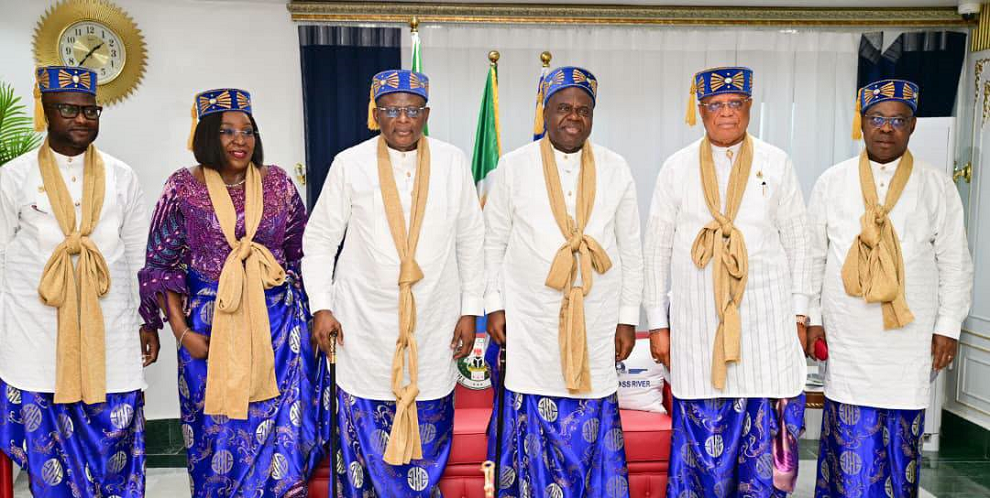
By Temitope Adebiyi, Correspondent
To speed up growth, Southsouth governors agreed yesterday to build a stronger regional economy through shared infrastructure, joint investments, maritime projects, and united talks with the federal government.
The Southsouth governors met for one day in Calabar, the capital of Cross River State, where Bayelsa State Governor Douye Diri chaired the session.
The governors built their regional economic plan on three main pillars: rail projects, port upgrades, and the Lagos-Calabar Coastal Highway..
The governors also resolved to institutionalise the Forum through quarterly meetings, with Uyo, Akwa Ibom State, scheduled to host the next meeting from November 6 to 8.
The Forum’s position followed a presentation by the Director-General of the BRACED Commission, Ambassador Joe Keshi, on strategies for strengthening regional infrastructure, with particular emphasis on rail development.
The National Chairman of the Pan Niger Delta Forum (PANDEF), Ambassador Godknows Boladei Igali, also canvassed the establishment of a regional investment fund capable of mobilising capital for projects of regional significance.
Igali urged the governors to make young people central to the region’s economic transformation, as the Southsouth seeks to convert its vast natural and human resources into sustainable employment, enterprise and wealth creation.
As host of the meeting, Cross River State Governor and Vice Chairman of the Forum, Senator Bassey Otu, said the region could only secure greater economic and political leverage through collective action.
Otu said the Southsouth possessed the resources and strategic advantages required to emerge as one of Nigeria’s most formidable economic blocs, but warned that fragmentation could continue to undermine its potential.
“We must come together as a people; we must cooperate, and we must ensure that our voice is heard and respected,” he said.
He called for a common regional position on issues of fiscal equity, particularly Value Added Tax, oil and gas revenues and the 13 per cent derivation benchmark.
The governor also sought the support of his colleagues for Cross River State’s campaign to regain its oil-producing status, presenting the demand as part of the state’s broader effort to expand its economic base and secure greater opportunities for its people.
On infrastructure, Otu proposed the development of an integrated economic corridor linking the Bakassi Deep Seaport in Calabar with the East-West Road and the ports in Bayelsa and Delta states.
He also advocated deeper integration of the region’s agricultural economies, urging the states to move beyond the export and consumption of raw commodities towards value addition, industrial processing and large-scale job creation.
According to him, cassava production, processing and ethanol development could form part of a broader regional industrialisation strategy capable of creating employment while strengthening local value chains.
“We cannot afford to remain a region of meetings and communiqués,” Diri said, stressing that every meeting of the Forum must produce “movement” and measurable progress.
The Bayelsa governor argued that many of the Southsouth’s challenges were regional in character and could not be effectively addressed through isolated state-level interventions.
Diri identified connectivity as fundamental to the region’s economic transformation, advocating accelerated development of road, rail, air and maritime infrastructure, including the East-West Road, Lagos-Calabar Coastal Highway and regional rail networks.
He said the Southsouth Corridor should deliberately position itself as “Nigeria’s gas-industrial hub, West Africa’s maritime gateway and the country’s leading blue-economy zone.”
Beyond economic expansion, the governors linked the region’s development ambitions to security and environmental sustainability, recognising that investment and industrial activity would remain vulnerable without adequate protection of communities, economic corridors and critical infrastructure.
The Forum therefore advocated stronger intelligence-sharing and coordinated security operations across the six states to protect communities, waterways, oil and gas installations and other strategic economic assets.
Environmental restoration also featured prominently in the governors’ deliberations, with Diri drawing attention to the paradox of a region that has contributed substantially to Nigeria’s wealth while bearing severe ecological consequences from decades of resource exploitation.
He called for expanded environmental remediation across the Niger Delta, arguing that economic development in the region must be accompanied by restoration of degraded communities and ecosystems.


Cabotage Enforcement is My Priority: DG NIMASA

Customs Renovates Ife Girls’ School, Pledges University Scholarships

Tinubu Applauds Coca-Cola’s Planned $1b Investment

2027: Northern Muslim Women Declare Support for President Tinubu

Dakuku Peterside: Weak Institutions Stall Nigeria’s Wealth, Prosperity

Inside Nigeria’s Sea Power: The Rise of NPA as a Maritime Powerhouse

Adebayo Williams At 75: A Missing Honour — By Femi Macaulay

High Hopes as Dangote Launches ₦2.15 Trillion IPO

2027: LP chieftain sues WAEC, UNN, NYSC over Obi’s credentials

Tension in Osun as Masked Gunmen Kill Adeleke’s Ally ‘Emir’ at Peace Meeting

Tribute to a Colossus: The Eternal Legacy of Alhaji Bamanga Tukur (1935–2026)

US Praises Nigeria for Ending 12-Year Maritime Restrictions; Oyetola Credits President Tinubu

Environmental sanitation resumes in Lagos tomorrow

Tribute to a Legal Icon and Master Administrator: Alhaji Yahaya Bukar-Gana

Panel recommends 60-month timeline on State Police inauguration

Customs smashes smuggling ring at Tin-Can port, seizes illicit drugs worth ₦18.9b

Customs nets ₦178b at PTML, Miko resumes office

NIMASA Calls on The Media to Help Drive Blue Economy Growth

NIMASA Partners Malta to Fast-Track Full Automation of Nigerian Ship Registry

History as Customs CG Adeniyi bags First NIJ alumnus fellowship

“A Blueprint for Prosperity: How Amb. (Engr.) Omar Suleiman Will Transform Adamawa State”

Apapa Customs Intercepts ₦12.7b ‘Canadian Loud’, Expired Drugs in Lagos

Misclassified Levies: Senate Clears Customs of ₦62.2bn Under-Remittance Claim
