
Economy
CHEAP FUEL VS. FAT BUDGETS: THE TINUBU-ATIKU 2027 SHOWDOWN

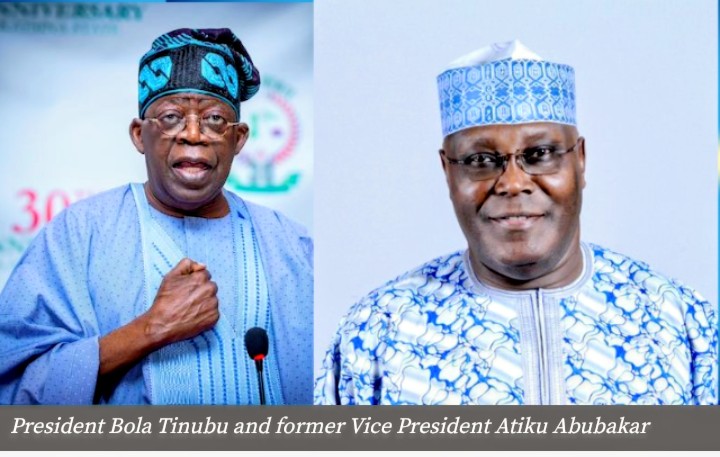
By Ibrahim Nasiru
The ideological battlefield for the 2027 presidential election has officially exploded, shifting away from standard identity politics to focus on the raw, painful reality of the Nigerian economy.
The first salvo was fired when former Vice President Atiku Abubakar, running as the Presidential flagbearer of the African Democratic Congress (ADC), announced an aggressive economic shift if elected, he will restore the petroleum subsidy.
President Bola Tinubu fired back instantly from the Presidential Villa, stating that Atiku’s proposal represents a profound ignorance of governance and a reckless disregard for the country’s fragile fiscal survival because before the fuel subsidy was removed in May 2023, Nigeria faced a severe fiscal crisis driven by unsustainable debt, massive corruption and smuggling leakages, foreign exchange shortages, and a low revenue-to-GDP ratio.
Before President Tinubu took over power, the presidency disclosed that the consumption-based subsidy drained trillions of naira, forcing previous governments to borrow heavily just to pay for fuel imports.
Unsustainable Debt: Subsidy payments consumed a massive share of national revenue, pushing public debt to over ₦77 trillion and forcing extensive borrowing and money printing
Depleted Public Funds: Billions spent on artificially low pump prices starved critical sectors like infrastructure, education, health, and power generation of necessary investments.
Foreign Exchange Crisis: Multiple exchange rates and severe dollar scarcity crippled business operations and depleted foreign reserves.
Rampant Corruption: The opaque subsidy regime was plagued by over-invoicing, round-tripping, and extensive fuel smuggling to neighboring countries.
Perennial Scarcity: Despite huge financial outlays, citizens routinely endured long queues and acute shortages at filling stations, with actual pump prices often far exceeding official caps on the black market.
Low Revenue Generation: Nigeria suffered from one of the lowest tax-to-GDP ratios globally, restricting the state’s capacity to finance public goods or buffer economic shocks.
The new position of Atiku exposes two fundamentally different visions for navigating Nigeria’s economic crisis
For the President Tinubu administration , the removal of the petrol subsidy is an unavoidable structural necessity required to save the country from absolute bankruptcy. The administration’s core defense also rely on the genuine mathematics of the Federation Account Allocation Committee (FAAC) spreadsheet which has increased geometrically.
The presidency pointed out that before May 2023, over 27 out of the 36 states of the federation were financially incapacitated and unable to pay civil servants’ salaries because the subsidy regime was swallowing national revenue.
Today, with the subsidy removed, FAAC allocations to all three tiers of government have surged, arming governors and local government chairmen with the financial capacity to fund infrastructure development, monthly salaries of civil servants, pensions, healthcare, and primary education among others.
But by reducing the complex, human crisis of hyperinflation to a mere accounting exercise, it seems the incumbent machine completely miscalculates the raw friction on the ground.
A state governor cannot feed hungry citizens with an unspent FAAC allocation. This is where Atiku Abubakar is carving out an alternative narrative that directly taps into the suffering of the masses.
Atiku’s argument is built on a direct audit of public accountability: he is not calling for a return to the old, corrupt import-driven subsidy model. Instead, he has unveiled a “targeted petroleum subsidy framework,” proposing to supply domestic refineries with crude oil at a capped, budgeted price below market rates, tracking every single barrel while forcing bad actors to refund stolen public funds.
The core of Atiku’s offensive shifts the argument from fiscal availability to institutional corruption. His central question to the administration is simple and devastating: Where is the money? The public was told that removing the subsidy would free up trillions of naira to tackle extreme poverty, secure rural communities, and fix our dilapidated public school system.
Yet, over three years into this fiscal experiment, the average Nigerian faces unprecedented transportation costs, soaring food prices. By framing the issue around human capital rather than procurement sheets, Atiku has position his party as the alternative.
True objectivity requires us to state clearly that both political heavyweights are trapped in their own contradictions. The state governors must answer why skyrocketing FAAC allocations have failed to translate into tangible relief or lower the cost of living for their people.
Meanwhile, the ADC candidate must convince a cynical electorate that his new “cheap fuel” domestic refinery model will not simply create a new playground for elite backroom arbitrage, corruption and round-tripping.
As the country stands at a critical economic crossroads ahead of 2027, the lines are firmly drawn. The electorate is being asked to choose between the cold, macroeconomic development and the new subsidy blueprint by Atiku The battle for the soul of Nigeria has truly begun, and the alternative vision is ready.
Chief Ibrahim Nasiru
A Public Affairs Analyst writes from Abuja, Nigeria.
NOTE:
Views expressed by contributors are strictly personal and not of The Spynews


Cabotage Enforcement is My Priority: DG NIMASA

Customs Renovates Ife Girls’ School, Pledges University Scholarships

Tinubu Applauds Coca-Cola’s Planned $1b Investment

2027: Northern Muslim Women Declare Support for President Tinubu

Dakuku Peterside: Weak Institutions Stall Nigeria’s Wealth, Prosperity

Inside Nigeria’s Sea Power: The Rise of NPA as a Maritime Powerhouse

Adebayo Williams At 75: A Missing Honour — By Femi Macaulay

High Hopes as Dangote Launches ₦2.15 Trillion IPO

2027: LP chieftain sues WAEC, UNN, NYSC over Obi’s credentials

Tension in Osun as Masked Gunmen Kill Adeleke’s Ally ‘Emir’ at Peace Meeting

Tribute to a Colossus: The Eternal Legacy of Alhaji Bamanga Tukur (1935–2026)

US Praises Nigeria for Ending 12-Year Maritime Restrictions; Oyetola Credits President Tinubu

Environmental sanitation resumes in Lagos tomorrow

Tribute to a Legal Icon and Master Administrator: Alhaji Yahaya Bukar-Gana

Panel recommends 60-month timeline on State Police inauguration

Customs smashes smuggling ring at Tin-Can port, seizes illicit drugs worth ₦18.9b

Customs nets ₦178b at PTML, Miko resumes office

NIMASA Calls on The Media to Help Drive Blue Economy Growth

NIMASA Partners Malta to Fast-Track Full Automation of Nigerian Ship Registry

History as Customs CG Adeniyi bags First NIJ alumnus fellowship

“A Blueprint for Prosperity: How Amb. (Engr.) Omar Suleiman Will Transform Adamawa State”

Apapa Customs Intercepts ₦12.7b ‘Canadian Loud’, Expired Drugs in Lagos

Misclassified Levies: Senate Clears Customs of ₦62.2bn Under-Remittance Claim
